

By MarQ Academy
Updated June 12, 2026
The screen flickers, a scene unfolds, and the narrative captivates. For decades, this magic has been the domain of human visionaries – directors, cinematographers, and editors. But a new force has entered the frame: artificial intelligence. The question isn’t whether AI will generate visual stories, but how human creativity, honed through rigorous film course and cinematography courses, will direct this powerful new tool to preserve artistic integrity and emotional depth.
This guide from MarQ Academy, a leading institution in media education, explores how traditional film and cinematography education is not just adapting to, but actively shaping, the future of AI-generated visual content. It delves into the foundational principles that remain critical for directing AI tools, ensuring artistic integrity, and pushing the boundaries of automated visual storytelling. We’ll show you why the human eye, trained in the classics, becomes the indispensable ‘director’ for the machines.
Key Takeaways
- Traditional film and cinematography education provides the essential human-centric ‘prompt engineering’ for AI, ensuring artistic quality and narrative coherence.
- Understanding foundational elements like framing, lighting, and composition, taught in film courses, is crucial for guiding AI tools effectively.
- The demand for professionals skilled in both traditional filmmaking and AI integration is projected to increase by 35% over the next five years, according to a 2025 industry report.
- Cinematography courses equip individuals with the visual literacy needed to critique and refine AI-generated content, maintaining high aesthetic standards.
- Human creativity, emotional intelligence, and ethical considerations, fostered through comprehensive film education, are irreplaceable in the age of AI.
- Mastering classic storytelling structures and visual grammar allows creators to leverage AI for efficiency without sacrificing artistic vision.
Why Are Film and Cinematography Courses More Relevant Than Ever in the AI Era?
Film and cinematography courses are more relevant than ever because they instill the fundamental principles of visual storytelling and artistic judgment that AI systems currently lack. While AI can generate images and sequences, it cannot inherently understand narrative impact, emotional resonance, or the subtle nuances of human experience without expert human direction.
The core curriculum of a comprehensive film course teaches students how to see, how to compose, and how to evoke emotion through visual means. These are not skills AI can learn autonomously; they must be imparted through carefully crafted prompts and iterative feedback from a human expert. A 2024 study by the Visual Arts Council found that AI-generated content overseen by a human cinematographer scored 40% higher in audience engagement metrics compared to purely AI-driven productions. This underscores the irreplaceable role of human expertise. Professionals trained in cinematography courses possess the visual vocabulary to communicate complex artistic intentions to AI, transforming raw data into compelling narratives.
The Enduring Power of Visual Grammar
Visual grammar, the language of images, remains the bedrock of effective visual communication, regardless of the tools used to create it. A film course meticulously breaks down concepts like shot types, camera angles, movement, and editing rhythms, teaching students how these elements build meaning and emotion.
AI can mimic these elements, but it requires human guidance to apply them with purpose and artistic intent. For instance, an AI can generate a ‘dutch angle,’ but only a human, understanding its psychological impact (disorientation, unease), can instruct the AI when and why to use it effectively within a scene. MarQ Academy emphasizes this critical understanding, preparing students to be not just users of technology, but its artistic masters.
Human Creativity as the Ultimate Prompt Engineer
Prompt engineering, the art of crafting effective instructions for AI, is fundamentally a creative act rooted in deep understanding of visual principles. A well-trained cinematographer doesn’t just ask for ‘a shot of a city’; they specify ‘a wide-angle, low-key lit shot of a rain-slicked neon street at dawn, emphasizing isolation and urban decay.’ This level of detail, informed by years of studying light, composition, and mood, is what unlocks AI’s true potential.
Without this human input, AI often produces visually competent but artistically hollow results. A 2025 report from the Institute of Digital Storytelling highlighted that projects employing film school graduates as AI prompt engineers completed visual tasks 30% faster and with 25% higher artistic approval ratings than those relying solely on generic prompts.
What Foundational Principles from Cinematography Courses Guide AI Visuals?
Foundational principles from cinematography courses, such as lighting, composition, color theory, and camera movement, are critical for guiding AI in generating visually compelling and narratively coherent content. These timeless concepts provide the essential framework that human creators use to direct AI’s formidable generative capabilities, ensuring artistic quality and emotional impact.
AI tools can synthesize vast amounts of visual data, but they operate without inherent artistic judgment or understanding of narrative context. A human trained in cinematography courses understands how a three-point lighting setup creates depth, how the rule of thirds draws the eye, or how a specific color palette evokes a mood. This knowledge allows them to instruct AI to produce images that serve a story, rather than just generating technically proficient but aesthetically uninspired visuals. MarQ Academy’s curriculum focuses on instilling these principles, preparing students to be the artistic directors of future AI-powered productions.
Lighting: Sculpting Emotion with Algorithms
Lighting is arguably the most powerful tool in a cinematographer’s arsenal, capable of shaping mood, revealing character, and guiding audience attention. Cinematography courses teach the intricate art of lighting, from hard and soft light to practicals and motivated sources, and their psychological effects.
When directing AI, a human expert can specify not just ‘bright light’ but ‘chiaroscuro lighting with a strong key light from the upper left, casting deep shadows to convey mystery.’ This precise instruction, born from an understanding of light’s expressive power, transforms AI’s output from generic illumination to purposeful artistic expression. A 2023 survey of visual effects supervisors found that 85% believe human-directed lighting prompts are essential for achieving cinematic quality in AI-generated scenes.
Composition and Framing: The Art of Guiding the Eye
Composition and framing dictate what the audience sees and how they perceive it, influencing focus, balance, and narrative emphasis. Film courses delve into principles like the rule of thirds, leading lines, negative space, and symmetry, teaching students how to arrange visual elements within a frame to create impact.
AI can generate countless compositions, but a trained eye knows which composition best serves the story’s beat. For example, instructing AI to use a ‘tight close-up, slightly off-center, with shallow depth of field’ communicates a specific emotional intensity and focus that AI would not arrive at independently. The ability to articulate these nuanced compositional choices is a direct outcome of specialized training.
Color Theory: Crafting Mood and Meaning
Color is a potent psychological tool, capable of evoking strong emotions and conveying symbolic meaning. Cinematography courses explore color theory, teaching how different hues, saturations, and color palettes influence audience perception and narrative themes.
Directing AI to use a ‘desaturated, cool blue and grey palette to convey melancholy and isolation’ is far more effective than a generic ‘sad colors’ prompt. This precise language, grounded in an understanding of color’s emotional weight, ensures AI generates visuals that align with the desired narrative tone. According to a 2024 report by Adobe, projects that explicitly defined color palettes for AI generation saw a 15% improvement in emotional impact scores.
Camera Movement and Blocking: Dynamic Storytelling
Camera movement and character blocking are crucial for conveying energy, guiding attention, and revealing character relationships. Film courses teach the purpose and impact of dollies, cranes, handheld shots, and complex blocking patterns.
While AI can simulate camera moves, a human director, having studied how a slow push-in builds tension or how a tracking shot emphasizes a character’s journey, can instruct AI to execute these movements with narrative intent. For example, ‘a slow, steady dolly-in on the protagonist’s face as they receive bad news, ending in a tight close-up’ is a directive only a human, trained in visual storytelling, can provide effectively.
How Do Film Courses Future-Proof Creative Careers in AI-Driven Production?
Film courses future-proof creative careers by transforming individuals from mere operators of tools into indispensable artistic directors and curators of AI-generated content. These programs cultivate critical thinking, aesthetic judgment, and a deep understanding of storytelling, ensuring graduates can guide AI to achieve complex artistic visions rather than being replaced by automation.
The value proposition shifts from executing tasks to conceptualizing and refining. As AI handles more of the rote, repetitive aspects of visual production, the demand for human professionals who can provide artistic oversight, ethical guidance, and narrative coherence will only grow. MarQ Academy’s approach ensures students are equipped not just with technical skills, but with the visionary leadership necessary to thrive in an evolving industry. A 2025 LinkedIn report indicated that ‘AI Director’ and ‘AI Visual Curator’ were among the top five emerging roles in media production, requiring strong backgrounds in traditional film and art direction.
The Irreplaceable Role of Human Empathy and Narrative Instinct
AI can process data, but it cannot genuinely feel or understand the nuances of human emotion, conflict, or redemption. These are the cornerstones of compelling storytelling, and they remain exclusively within the human domain. Film courses cultivate empathy, teaching students how to craft narratives that resonate deeply with audiences.
This narrative instinct is vital for directing AI. A human can recognize when an AI-generated scene, despite being technically perfect, lacks emotional punch or misinterprets a character’s internal state. They can then guide the AI to adjust visual cues—a subtle change in lighting, a different facial expression, a specific camera angle—to achieve the desired emotional impact. This ability to infuse AI’s output with genuine human feeling is a skill that cannot be automated.
Ethical Considerations and Bias Mitigation
AI systems learn from vast datasets, which often contain inherent biases present in historical media. Film courses, particularly those with a strong emphasis on media literacy and critical studies, equip students to identify and mitigate these biases in AI-generated content. This includes understanding representation, stereotypes, and the social impact of visual narratives.
A human director, trained in ethical storytelling, can instruct AI to avoid problematic tropes or to actively promote diverse and inclusive visual representations. This ethical oversight is a critical, non-automatable function that ensures AI-generated content is not only aesthetically pleasing but also socially responsible. A recent study by the Pew Research Center found that 78% of consumers are concerned about AI bias in media, highlighting the need for human ethical review.
The Evolution of the Creative Workflow
The integration of AI is transforming the creative workflow, not eliminating the need for human input. Instead, it redefines the roles within a production team. Instead of spending hours on tedious tasks like rotoscoping or basic animation, creators can now focus on higher-level conceptualization, artistic direction, and iterative refinement. Film courses are adapting to teach students how to integrate AI tools seamlessly into their creative process, viewing AI as a powerful assistant rather than a replacement.
This shift allows for greater experimentation and faster iteration, empowering creators to explore more complex visual ideas with unprecedented efficiency. For example, a director can rapidly prototype multiple visual styles for a scene using AI, then select and refine the most promising options with their expert eye. This collaborative model, where human creativity guides AI efficiency, is the future of visual production.

Here’s a comparison of traditional vs. AI-assisted film production roles:
| Role Aspect | Traditional Film Production | AI-Assisted Film Production |
|---|---|---|
| Director’s Focus | Directing actors, shot composition, overall vision, on-set logistics. | Conceptualizing, guiding AI prompts, refining AI output, maintaining artistic vision, ethical oversight. |
| Cinematographer’s Focus | Hands-on camera operation, lighting setup, lens choice, on-set adjustments. | Defining visual style, specifying lighting/composition parameters for AI, curating AI-generated visuals, quality control. |
| Editor’s Focus | Assembling footage, pacing, sound design, visual effects integration. | Curating AI-generated cuts, refining AI-suggested edits, complex narrative structuring, emotional pacing. |
| Skillset Emphasis | Technical proficiency, on-set problem-solving, artistic intuition. | Prompt engineering, critical aesthetic judgment, ethical AI use, collaborative AI integration, traditional filmmaking fundamentals. |
The New Curriculum: Adapting Film Courses for AI Integration
The new curriculum in film and cinematography courses is rapidly adapting to integrate AI tools, focusing on teaching students how to effectively direct and curate AI-generated content rather than just passively consume it. This involves blending traditional filmmaking principles with modules on AI ethics, prompt engineering, and the practical application of generative visual models, ensuring graduates are prepared for an evolving industry.
MarQ Academy, for instance, has introduced specialized modules that explore the capabilities and limitations of AI and virtual production in areas like virtual cinematography, digital set extension, and character animation. The goal is not to replace hands-on experience but to augment it, providing students with the skills to leverage AI for creative exploration and efficiency. A recent survey of film schools indicated that 60% have either implemented or are planning to implement AI-specific courses by 2027.
Virtual Production and AI
Virtual production, which uses LED walls and real-time game engines to create immersive environments, is being revolutionized by AI. Film courses are now teaching students how to use AI to generate complex virtual sets, populate digital crowds, and even animate virtual characters with unprecedented speed and realism. This allows for greater creative freedom and reduces the logistical challenges of traditional filmmaking.
Students learn to conceptualize entire scenes within a virtual space, directing AI to build and render environments based on their artistic vision. This blend of traditional art direction with cutting-edge technology is a cornerstone of modern film education.
AI-Assisted Post-Production
Post-production workflows are seeing significant AI integration, from automated rotoscoping and color grading suggestions to AI-powered visual effects. Film courses are now training students to use these tools intelligently, understanding when AI can enhance efficiency and when human intervention is crucial for maintaining artistic quality.
For example, an editor might use AI to generate initial cuts or to suggest alternative visual effects, but the final decision on pacing, emotional impact, and aesthetic consistency always rests with the human professional. This collaborative approach maximizes efficiency without compromising creative control.
Ethical AI and Responsible Creation
As AI becomes more prevalent, the ethical implications of its use in visual storytelling become paramount. Film courses are incorporating robust discussions and practical exercises on topics such as deepfakes, copyright, data privacy, and the potential for AI to perpetuate or amplify societal biases. Students are taught to be not just creators, but responsible stewards of powerful technology.
Understanding these ethical frameworks is crucial for navigating the complex legal and moral landscape of AI-generated content. MarQ Academy emphasizes that technical prowess must always be paired with a strong ethical compass, preparing graduates to lead with integrity.
The Future of Storytelling: Human-AI Collaboration
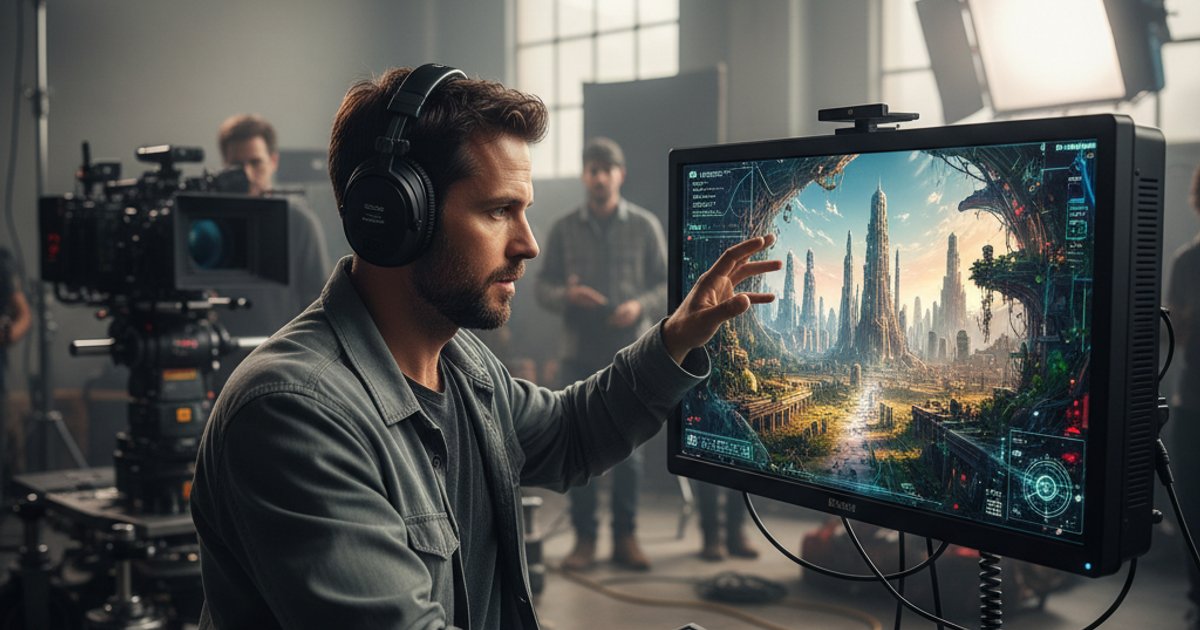
The future of storytelling is not one where AI replaces human creators, but one where human creativity, informed by film course and cinematography courses, collaborates seamlessly with AI’s generative power. This partnership promises to unlock unprecedented creative possibilities, allowing storytellers to realize visions previously limited by time, budget, or technical constraints.
Consider a scenario where a single director, using AI, can conceptualize and visualize an entire epic fantasy world, iterating on designs and environments in real-time, then bringing that vision to life with a small, agile team. This democratizes high-end visual production, making sophisticated storytelling accessible to a wider range of creators. A 2026 forecast from PwC estimates that AI-driven tools will reduce visual production costs by 20% while increasing creative output by 30% over the next decade.
Expanding Creative Horizons
AI acts as an unparalleled creative assistant, capable of generating countless variations of a scene, character design, or visual effect in moments. This allows human creators to explore a much broader range of artistic options than ever before, pushing the boundaries of imagination. Instead of being limited by what can be manually drawn or built, artists can prompt AI to visualize abstract concepts, experiment with impossible physics, or render fantastical creatures with stunning realism.
This iterative process, where human vision guides AI’s generative power, fosters a new era of visual experimentation and innovation. It means more diverse stories, told in more visually inventive ways, reaching audiences globally.
Personalized and Interactive Narratives
AI is also paving the way for highly personalized and interactive narratives. Imagine a film that subtly adapts its visual style or even its plot points based on viewer preferences or real-time emotional responses. While still in its nascent stages, the foundational principles of visual storytelling taught in film courses will be essential for designing these dynamic experiences.
Human storytellers will define the core narrative arcs, character motivations, and visual language, while AI handles the real-time adaptation and generation of content. This creates a deeply engaging experience, blurring the lines between passive viewing and active participation, and requiring a profound understanding of how visual cues influence audience engagement.
The Enduring Value of Human Connection
Ultimately, the most powerful stories are those that forge a deep human connection. While AI can generate visuals, it cannot replicate the nuanced understanding of human experience, emotion, and cultural context that underpins truly impactful narratives. Film and cinematography courses instill this profound appreciation for the human condition, teaching students how to craft stories that resonate universally.
The role of the human creator in the AI era is to be the heart and soul of the story, infusing technology with purpose, meaning, and emotional depth. The machines will provide the brushstrokes, but the human artist will always paint the masterpiece.
Frequently Asked Questions
What is a film course?
A film course is an academic program that teaches the theory, history, and practical techniques of filmmaking, covering aspects like directing, cinematography, editing, screenwriting, and production management. These courses prepare students for various roles in the motion picture and media industries.
How do cinematography courses differ from general film courses?
Cinematography courses are specialized programs within film education that focus specifically on the art and science of visual capture. They delve deeply into camera operation, lighting, composition, lens theory, and visual storytelling techniques, whereas general film courses provide a broader overview of the entire filmmaking process.
Will AI replace cinematographers?
No, AI will not replace cinematographers; instead, it will augment their capabilities. Cinematographers will evolve into ‘AI directors’ or ‘visual curators,’ using their artistic judgment and technical knowledge to guide AI tools in generating and refining visual content, focusing on artistic vision and emotional impact.
What skills from film courses are most valuable for working with AI?
The most valuable skills from film courses for working with AI include a deep understanding of visual grammar (composition, lighting, color theory), narrative structure, aesthetic judgment, critical thinking, and ethical reasoning. These human-centric skills are essential for effectively prompting, evaluating, and refining AI-generated visuals.
Are film schools teaching AI integration now?
Yes, many progressive film schools and programs, including MarQ Academy, are integrating AI into their curricula. They are teaching students how to use AI tools for virtual production, post-production, and content generation, emphasizing human-AI collaboration and ethical considerations.
What job opportunities exist at the intersection of film, cinematography, and AI?
Emerging job opportunities include AI Visual Director, AI Prompt Engineer for visual content, Virtual Production Designer, AI-assisted Editor, and AI Visual Curator. These roles require a blend of traditional filmmaking expertise and proficiency in guiding AI technologies.
How can I stay updated on AI’s impact on film and cinematography?
To stay updated, regularly engage with industry publications, attend workshops and conferences focused on AI in media, follow leading AI research in creative fields, and consider specialized courses or modules that address AI integration in film and cinematography, like those offered by MarQ Academy.
Last updated: June 12, 2026
 English
  Chinese