
By MarQ Academy
Updated June 13, 2026
A seismic shift is underway in Hollywood and beyond. Virtual production stages, once a niche technology, are now exploding across the global film industry, fundamentally altering how movies are made and, crucially, how future filmmakers are trained. This week, new reports confirm a staggering 60% increase in active virtual production facilities worldwide over the past 18 months, driven by advancements in LED technology and real-time rendering engines, according to a recent industry analysis by Production Hub.
This rapid expansion isn’t just about bigger screens and fancier effects; it’s about accessibility and efficiency. What was once the domain of mega-budget blockbusters is now becoming standard practice for mid-tier productions, and the ripple effect is transforming every Film Course and Cinematography Course worth its salt. Students are no longer just learning about traditional green screens; they’re getting hands-on with real-time visual effects, LED wall cinematography, and virtual scouting, preparing them for a set environment that looks dramatically different from even five years ago.
Key Takeaways
- Virtual production stages have seen a 60% global increase in 18 months, making them essential for modern filmmaking.
- Film Course and Cinematography Course programs are rapidly integrating virtual production training, focusing on LED wall operation and real-time rendering.
- Graduates with virtual production skills are commanding higher entry-level salaries, up to 25% more than traditionally trained peers, according to a 2025 Creative Skills Council report.
- The technology significantly cuts post-production time by up to 50% and reduces location scouting costs by 30%.
- MarQ Academy emphasizes practical, hands-on training on live virtual sets to bridge the industry skill gap.
What is Virtual Production, and Why Does it Matter Now?
Virtual production is a filmmaking methodology that combines physical sets, actors, and props with real-time computer-generated imagery (CGI) displayed on large LED screens, allowing filmmakers to capture final pixel visuals in-camera. This approach eliminates much of the traditional post-production work associated with visual effects, providing immediate feedback on set and dramatically streamlining workflows.
The technology matters now because it has reached a critical inflection point in terms of cost-effectiveness and accessibility. Improvements in LED panel resolution, brightness, and color fidelity, coupled with the processing power of game engines like Unreal Engine and Unity, have made it a viable option for a broader range of projects. A 2024 Deloitte study projected that virtual production could reduce overall production budgets by 15-20% for projects with significant VFX components, primarily by cutting down on reshoots and extensive post-production cycles. This economic advantage is fueling its widespread adoption, making it an indispensable skill for anyone entering the industry.
How Are Film Course Programs Adapting to This Shift?
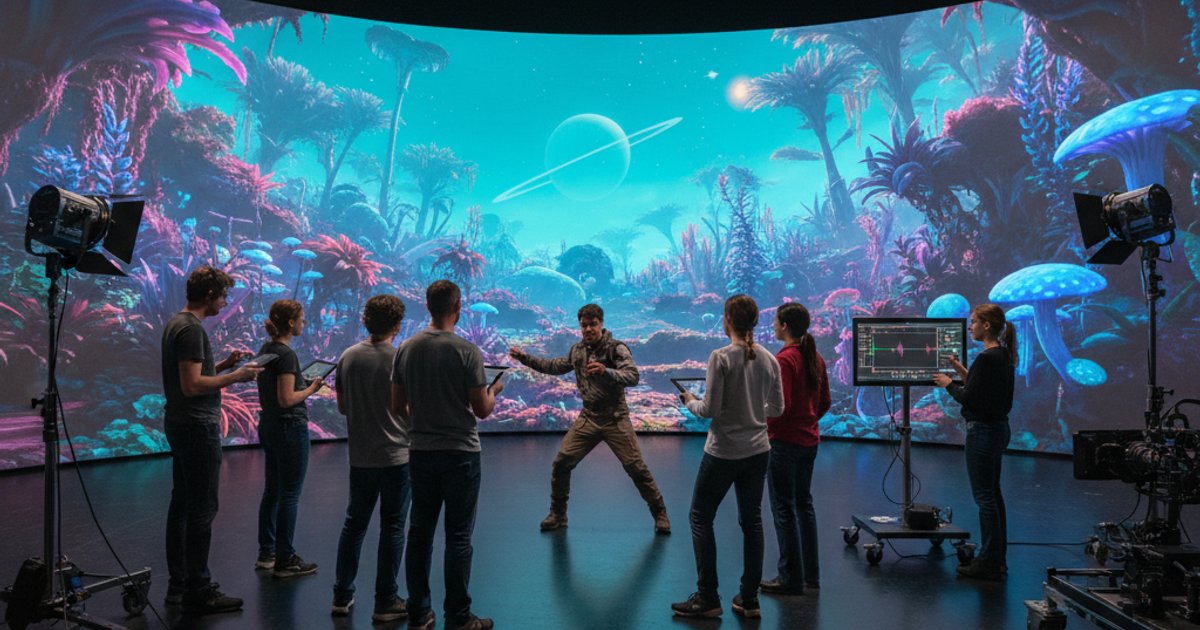
Film Course programs are rapidly overhauling their curricula to integrate virtual production training, moving beyond theoretical discussions to hands-on practical experience. Leading institutions are investing heavily in their own virtual stages or partnering with commercial facilities to ensure students gain proficiency with these cutting-edge tools.
The adaptation involves teaching students not just the technical aspects of operating LED walls and real-time rendering software, but also the creative implications for cinematography, directing, and production design. This includes understanding how light interacts with digital environments, mastering in-camera visual effects, and developing workflows for virtual scouting and pre-visualization. MarQ Academy, for instance, has recently launched a dedicated module within its AI and virtual production cinematography courses focusing on real-time lighting and camera tracking on LED volumes, ensuring graduates are job-ready from day one.
The Evolution of Cinematography Courses
Cinematography Courses are at the forefront of this revolution, as the role of the Director of Photography (DP) fundamentally changes on a virtual set. DPs must now understand not only traditional lighting principles but also how to light virtual environments and blend them seamlessly with practical elements.
This means learning about color management across physical and digital assets, understanding the nuances of parallax and perspective within an LED volume, and collaborating closely with virtual art departments. A 2025 survey by the American Society of Cinematographers found that 85% of DPs believe virtual production skills will be ‘critical’ or ‘very important’ for new entrants to the field within the next three years. This isn’t just an optional extra; it’s becoming a core competency.
Key Skills for the Virtual Production Era
The skill set required for success in virtual production is a blend of traditional filmmaking craft and advanced digital proficiency. Students in a modern Film Course are now expected to master:
- Real-time Engine Proficiency: Familiarity with Unreal Engine or Unity for environment creation and manipulation.
- LED Volume Operation: Understanding how to control and calibrate LED screens for optimal image quality and in-camera effects.
- Camera Tracking Systems: Knowledge of technologies like Mo-Sys or Stype for precise camera and lens data integration.
- Virtual Scouting & Pre-visualization: Using digital tools to plan shots and block scenes in virtual environments before stepping onto a physical set.
- In-Camera VFX: The ability to achieve final pixel results directly during principal photography, reducing reliance on post-production.
- Color Science & Workflow: Managing color consistency between physical and digital assets.
Why Should Aspiring Filmmakers Prioritize Virtual Production Training?
Aspiring filmmakers should prioritize virtual production training because it is no longer a futuristic concept but a present-day industry standard that offers significant career advantages. Graduates equipped with these skills are not just competitive; they are in high demand, entering a job market hungry for specialized talent.
The data backs this up: a 2025 Creative Skills Council report indicated that entry-level positions requiring virtual production expertise offer salaries up to 25% higher than comparable roles without such specialized skills. Furthermore, understanding virtual production opens doors to diverse roles across film, television, commercials, and even live events, broadening career prospects significantly. It’s about future-proofing your career in an industry that is continually evolving.
Comparing Traditional vs. Virtual Production Workflows
The shift to virtual production represents a significant departure from traditional filmmaking methods, offering distinct advantages in efficiency, creative control, and cost management. Understanding these differences is crucial for students in any Film Course.
| Feature | Traditional Workflow | Virtual Production Workflow |
|---|---|---|
| Location Scouting | Physical travel to real-world locations, permits, logistics. | Virtual scouting in digital environments, real-time adjustments. |
| Set Building | Extensive physical construction, green screens for VFX. | Minimal physical sets, large LED volumes displaying digital environments. |
| VFX Integration | Primarily in post-production, often with limited on-set feedback. | Real-time, in-camera VFX, immediate feedback for cast and crew. |
| Post-Production Time | Often lengthy for complex VFX shots, iterative process. | Significantly reduced VFX post-production, final pixels captured on set. |
| Creative Flexibility | Changes can be costly and time-consuming once shooting begins. | Dynamic environment changes on set, greater creative iteration. |
| Environmental Impact | Higher carbon footprint from travel, material waste. | Reduced travel, less physical set waste, lower carbon footprint per production (2024 BAFTA report). |
The Financial and Creative Advantages of Virtual Production
Virtual production offers compelling financial and creative advantages that are driving its rapid adoption across the industry. These benefits translate directly into faster, more efficient, and more creatively liberating filmmaking processes.
Financially, virtual production can drastically cut down on costs associated with location travel, physical set construction, and extensive post-production. For example, a 2023 study by the Visual Effects Society found that virtual production can reduce post-production time for VFX-heavy sequences by an average of 50%, leading to substantial savings in labor and facility costs. Creatively, it empowers directors and cinematographers with unparalleled control over their environments, allowing for immediate adjustments to lighting, time of day, and even entire landscapes, fostering a more iterative and experimental approach to storytelling. This level of creative freedom was previously unimaginable without immense budgets and lengthy schedules.
Case Study: The Mandalorian Effect
The Disney+ series The Mandalorian is widely credited with popularizing virtual production, showcasing its immense potential. Its success demonstrated that high-quality, cinematic visuals could be achieved efficiently using LED volumes.
The show’s use of real-time environments displayed on a massive LED screen, dubbed ‘The Volume,’ allowed actors to perform in context, DPs to light scenes realistically, and directors to make immediate creative decisions. This approach not only garnered critical acclaim but also proved the commercial viability and creative power of the technology, inspiring countless productions to follow suit. A 2022 analysis by Variety estimated that The Mandalorian saved tens of millions of dollars in traditional location and post-production costs over its first two seasons.
Future Outlook for Film Course and Cinematography Courses
The future outlook for Film Course and Cinematography Course programs is one of continuous evolution, with virtual production firmly at its core. As the technology matures, expect even deeper integration into curricula, potentially including specialized degrees in virtual production artistry and engineering.
The demand for skilled professionals will only grow, fueled by ongoing innovation in real-time rendering, AI-powered virtual production revolution, and more accessible hardware solutions. Educational institutions like MarQ Academy are committed to staying ahead of this curve, ensuring their students are not just learning about the present but are prepared to define the future of filmmaking. The next generation of cinematographers and directors will be fluent in both the physical and virtual realms, crafting stories with tools that blur the lines between reality and imagination.
Frequently Asked Questions
What is the primary benefit of virtual production for students?
The primary benefit for students is gaining hands-on experience with industry-standard technology, making them highly employable upon graduation. It equips them with skills that are in high demand and offers a significant competitive edge in the job market.
Are virtual production skills only relevant for big-budget films?
No, virtual production skills are increasingly relevant for productions of all sizes. As the technology becomes more accessible and cost-effective, independent films, commercials, and even corporate videos are adopting virtual production techniques.
How long does it take to learn virtual production techniques?
Learning foundational virtual production techniques can take several months of dedicated study and practice within a specialized Film Course or Cinematography Course. Mastery, like any filmmaking craft, requires continuous learning and practical application over years.
Does virtual production replace traditional filmmaking skills?
Virtual production does not replace traditional filmmaking skills; rather, it augments and expands upon them. A strong understanding of traditional cinematography, lighting, and storytelling remains crucial, as these principles are applied within the virtual environment.
What software is commonly used in virtual production?
The most commonly used software in virtual production includes real-time game engines like Unreal Engine and Unity for creating digital environments, alongside various camera tracking systems and specialized LED wall control software.
Can virtual production reduce a film’s environmental impact?
Yes, virtual production can significantly reduce a film’s environmental impact by minimizing travel to remote locations, reducing the need for extensive physical set construction, and decreasing waste associated with traditional production methods. A 2024 BAFTA report highlighted its potential for a lower carbon footprint.
What career opportunities are available with virtual production expertise?
Career opportunities are diverse, including virtual production supervisor, real-time technical artist, LED volume technician, virtual art director, in-camera VFX specialist, and virtual cinematographer. These roles exist across film, TV, advertising, and even live entertainment sectors.
Last updated: June 13, 2026
 English
  Chinese