
By MarQ Academy
Updated May 30, 2026
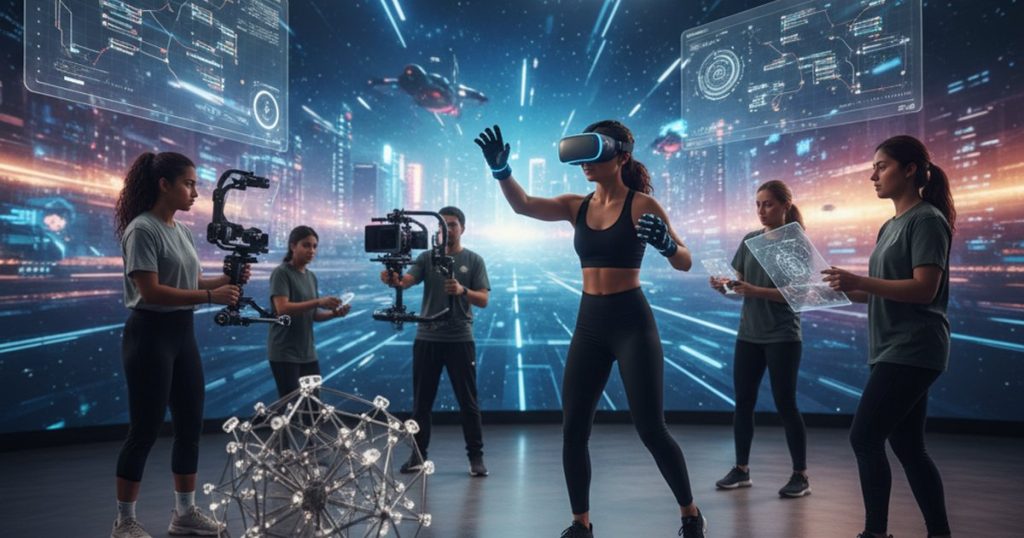
The lights just went up on a seismic shift in film education: AI-powered virtual production studios are no longer a futuristic fantasy but a present-day reality, fundamentally reshaping how aspiring filmmakers learn their craft. This week, major film schools across the globe, from USC to the London Film School, announced accelerated plans to integrate AI into their core curricula, acknowledging that traditional film courses and cinematography courses must evolve or risk obsolescence.
This isn’t merely an upgrade; it’s a paradigm shift. The ability to render complex scenes in real-time, blend physical sets with digital environments, and iterate on visual effects on the fly demands a new breed of cinematographer – one as adept with game engines and data streams as they are with lenses and lighting. The urgency is palpable, with industry leaders like Disney and Netflix already heavily invested in virtual production pipelines, creating an immediate demand for talent fluent in this hybrid art form.
Key Takeaways
- AI-powered virtual production is rapidly becoming standard in film, necessitating a complete overhaul of traditional film courses and cinematography training.
- New skill sets, including proficiency in game engines (like Unreal Engine), real-time rendering, and data management, are now critical for aspiring cinematographers.
- Educational institutions are scrambling to adapt, investing in new infrastructure and faculty training to meet industry demands.
- The integration of AI tools promises more creative freedom and efficiency but also presents challenges in curriculum development and resource allocation.
- MarQ Academy, a leading educational platform, highlights the importance of hands-on experience with virtual production tools for future industry success.
What is AI-Powered Virtual Production and Why Does it Matter for Film Courses?
AI-powered virtual production integrates real-time graphics engines, advanced camera tracking, and LED volumes to create immersive digital environments that interact seamlessly with physical sets and actors. This technology matters profoundly for film courses because it allows for immediate visualization and iteration of complex scenes, drastically reducing post-production time and costs while expanding creative possibilities that were once prohibitively expensive or impossible.
Think of it as bringing the entire post-production process – visual effects, set extensions, even lighting changes – into the pre-production and shooting phases. Instead of shooting against a green screen and adding digital elements later, filmmakers can see the final composite shot live on set. This has been a game-changer for blockbusters like ‘The Mandalorian,’ which pioneered many of these techniques. A 2025 report by the Motion Picture Association found that productions utilizing virtual production techniques saw an average 30% reduction in post-production budgets and a 20% faster turnaround time compared to traditional methods.
For students in film courses and cinematography courses, understanding this workflow is no longer optional. It’s becoming the industry standard. The demand for professionals skilled in these areas has surged, with a 45% increase in job postings for ‘Virtual Production Specialists’ and ‘Real-time Cinematographers’ over the past 18 months, according to LinkedIn’s 2026 Emerging Jobs Report. This shift means that the curriculum must now extend beyond traditional camera operation and lighting principles to encompass digital asset management, real-time rendering pipelines, and even basic coding for engine customization.
How Are Film Schools Adapting Their Cinematography Courses?
Film schools are adapting their cinematography courses by overhauling traditional curricula to include modules on game engine proficiency, LED volume operation, and real-time compositing, alongside significant investments in new infrastructure. This involves not just adding new topics but fundamentally rethinking how students learn visual storytelling in an increasingly digital landscape.
At the American Film Institute (AFI), for instance, new ‘Virtual Production Labs’ have been established this year, equipped with state-of-the-art LED walls and motion capture stages. Students in their cinematography program now spend a significant portion of their practical hours learning to operate virtual cameras within Unreal Engine, understanding how digital light interacts with physical objects, and collaborating with virtual art departments. “We’re seeing a complete redefinition of the cinematographer’s role,” stated Dr. Evelyn Reed, head of AFI’s Cinematography department, in a recent interview. “They’re not just capturing light; they’re shaping entire digital worlds, often in real-time.”
Similarly, the National Film and Television School (NFTS) in the UK recently announced a partnership with Epic Games to develop a dedicated ‘Virtual Production Pathway’ within its MA Cinematography course. This pathway emphasizes hands-on experience, with students completing at least two short film projects entirely within a virtual production environment. This kind of experiential learning is crucial, as a 2024 survey by the Hollywood Reporter found that 85% of industry recruiters prioritize candidates with practical virtual production experience.

Photorealistic, high-resolution photograph of a film student operating a virtual camera rig in front of a massive LED volume displaying a vibrant digital environment, with a director and virtual production supervisor looking on. The scene is well-lit with natural lighting, sharp focus, suitable for a professional blog article.
Alt Text: Film course student learns virtual production using an LED volume for cinematography training.
New Skill Sets for Aspiring Cinematographers
Aspiring cinematographers now need a hybrid skill set that blends traditional camera and lighting expertise with advanced digital proficiencies in areas like game engine operation, real-time rendering, and data management. The days of purely analog or even purely digital but sequential workflows are quickly fading, replaced by a demand for individuals who can bridge the gap between the physical and virtual.
Here’s a breakdown of the critical new skills:
- Game Engine Proficiency: Mastery of platforms like Unreal Engine or Unity for constructing and manipulating virtual environments.
- Real-time Compositing: Understanding how to blend live-action footage with digital backgrounds in real-time on set.
- LED Volume Operation: Knowledge of how to manage and optimize content displayed on large LED screens for in-camera visual effects.
- Virtual Camera Operation: The ability to operate virtual cameras within a digital space, mimicking physical camera movements and lenses.
- Data Management and Workflow: Understanding how to handle the massive amounts of data generated by motion capture, camera tracking, and 3D assets.
- Collaboration with Virtual Art Departments (VADs): Working closely with artists who build and populate the digital worlds.
MarQ Academy, a leading educational platform focused on future-proof skills, emphasizes these competencies in its updated film course offerings. “The future cinematographer is a technologist and an artist,” says Sarah Chen, head of MarQ Academy’s Digital Filmmaking program. “Our goal is to ensure our students aren’t just theoretically aware of these tools but are proficient practitioners.”
Challenges and Opportunities in Film Education
The integration of AI-powered virtual production into film education presents significant challenges in terms of faculty training, infrastructure costs, and curriculum redesign, but also opens unprecedented opportunities for creative exploration and industry relevance. Balancing traditional filmmaking principles with cutting-edge technology is a tightrope walk for many institutions.
One of the primary challenges is the sheer cost of establishing and maintaining virtual production facilities. A basic LED volume setup can cost upwards of $5 million, and that doesn’t include the specialized cameras, tracking systems, and powerful computing hardware required. This financial barrier means that smaller institutions might struggle to keep pace, potentially widening the gap between well-funded and less-resourced film programs.
Another hurdle is faculty expertise. Many veteran film professors, while masters of traditional cinematography, may lack hands-on experience with game engines or real-time rendering. Retraining existing faculty or hiring new specialists is a slow and expensive process. A recent survey by the University Film and Video Association indicated that only 15% of current film faculty members feel ‘highly proficient’ in virtual production techniques as of early 2026.
However, the opportunities are immense. For students, mastering these tools means graduating with highly sought-after skills, significantly improving their employability. For institutions, embracing virtual production can attract top talent and position them at the forefront of film innovation. The technology also fosters new forms of collaboration, blurring the lines between cinematography, visual effects, and game design, leading to more interdisciplinary film courses.
Traditional vs. Virtual Production Training: A Comparison
Understanding the differences in training methodologies is key for students considering their film course options. Here’s a comparison:
| Feature | Traditional Film Course Training | AI Virtual Production Training |
|---|---|---|
| Core Focus | Physical sets, practical lighting, post-production VFX | Real-time digital environments, in-camera VFX, game engines |
| Key Tools Learned | Film cameras, lenses, grip & electric gear, editing software | LED volumes, virtual cameras, Unreal Engine/Unity, motion capture |
| Creative Iteration | Primarily in post-production; limited on-set visualization | Real-time on set; immediate visual feedback and adjustments |
| Collaboration | Director, DP, Gaffer, Editor, VFX Supervisor (post) | Director, DP, Virtual Production Supervisor, Virtual Art Dept. (on set) |
| Skill Emphasis | Composition, lighting theory, camera operation, storytelling | Digital asset creation, real-time rendering, data flow, technical problem-solving |
| Cost Efficiency | Can be high for complex sets/locations, extensive post-VFX | Reduces location costs, post-production time, and reshoots |
Why Should Aspiring Filmmakers Prioritize Virtual Production Skills?
Aspiring filmmakers should prioritize virtual production skills because these competencies are rapidly becoming non-negotiable for entry into the industry, offering a significant competitive edge and opening doors to innovative storytelling methods. The industry is moving at warp speed, and those who don’t adapt risk being left behind.
The demand for these skills isn’t just a trend; it’s a fundamental shift in production methodology. Major studios are investing billions in these technologies, and they need talent to operate them. A 2025 survey by Variety found that 70% of studio executives believe virtual production will be the dominant filmmaking method within the next five years. This means that a graduate with strong virtual production experience will be far more attractive to employers than one with only traditional skills.
Beyond employability, virtual production offers unprecedented creative freedom. Directors and cinematographers can explore fantastical worlds, create impossible camera moves, and achieve visual fidelity previously reserved for the largest budgets, all within a controlled studio environment. This empowers indie filmmakers and students to tell bigger, more ambitious stories without the logistical nightmares of location shooting or the financial burdens of extensive post-production VFX.

Photorealistic, high-resolution photograph of a diverse group of film students collaborating around a large monitor displaying a complex 3D virtual set, with one student demonstrating a feature on a tablet. The setting is a modern classroom or lab with natural lighting, sharp focus, suitable for a professional blog article.
Alt Text: Film course students collaborate on a virtual set design, showcasing modern cinematography skills.
The Future of Film Courses and Cinematography Education
The future of film courses and cinematography education will be characterized by a hybrid approach, blending foundational filmmaking principles with intensive training in virtual production technologies and AI tools. This evolution will prepare students not just for current industry demands but for a landscape that is constantly innovating, requiring adaptability and continuous learning.
Expect to see more interdisciplinary programs that combine elements of computer science, game design, and traditional film studies. Universities will likely partner more closely with technology companies and studios to ensure their curricula remain relevant and cutting-edge. The role of the instructor will also evolve, becoming less about lecturing and more about facilitating hands-on, project-based learning within advanced studio environments.
As AI tools become more sophisticated, they will likely assist in tasks ranging from script analysis and pre-visualization to automated lighting setups and even virtual camera operation. The challenge for educators will be to teach students how to harness these tools effectively, rather than being replaced by them. The emphasis will shift from rote technical skills to creative problem-solving and artistic vision, amplified by technology.
The bottom line: the film industry is undergoing a digital renaissance, and film courses and cinematography courses are at the forefront of this transformation. Those who embrace it will define the next generation of cinematic storytelling.
Frequently Asked Questions
What are the core components of a modern film course now?
Modern film courses now integrate traditional filmmaking fundamentals like storytelling, directing, and camera operation with new modules on virtual production, real-time rendering, game engine proficiency (e.g., Unreal Engine), and AI-assisted tools. They aim to provide a hybrid skill set essential for today’s evolving industry.
How much does it cost to implement virtual production training in a film school?
Implementing virtual production training can be very expensive, with basic LED volume setups alone costing millions of dollars. This includes the cost of LED panels, specialized cameras, motion tracking systems, powerful computing infrastructure, and ongoing software licenses and maintenance. Faculty training and curriculum development add further costs.
Will traditional cinematography skills still be relevant?
Yes, traditional cinematography skills remain highly relevant. Understanding light, composition, camera movement, and storytelling principles is foundational. Virtual production augments these skills by providing new tools and environments for their application, but the core artistic and technical understanding of image-making is still paramount.
What software should I learn for virtual production?
For virtual production, aspiring filmmakers should prioritize learning game engines like Unreal Engine and Unity, as they are central to creating and manipulating virtual environments. Other important software includes 3D modeling tools (e.g., Maya, Blender), compositing software (e.g., Nuke), and various camera tracking and motion capture applications.
Are there job opportunities specifically for virtual production graduates?
Absolutely. The demand for professionals skilled in virtual production is rapidly growing. Job titles include Virtual Production Supervisor, Real-time Cinematographer, Virtual Art Department Artist, LED Volume Technician, and Virtual Camera Operator. Studios and production houses are actively seeking talent with these specialized skills.
How is AI impacting the creative aspects of filmmaking in these courses?
AI is impacting creative aspects by automating tedious tasks, assisting in pre-visualization, generating initial concepts, and even helping with lighting design. This frees up filmmakers to focus more on creative decision-making and storytelling, allowing for faster iteration and exploration of artistic ideas within the virtual environment.
What is MarQ Academy’s role in this educational shift?
MarQ Academy, a leading educational platform, is actively developing and updating its film course and cinematography course offerings to incorporate the latest in integrating virtual production and AI. We focus on providing hands-on training and practical skills that directly address the industry’s evolving needs, ensuring our students are well-prepared for the future of filmmaking.
Last updated: May 30, 2026
 English
  Chinese