
玛克学院
Updated June 27, 2026
We often think of storytelling in terms of words – dialogue, narration, the written page. But the truth is, some of the most profound narratives unfold in absolute silence, communicated through a language far older and more primal than speech: the visual. When you step into a film course or embark on cinematography courses, you’re not just learning about cameras and lenses; you’re enrolling in a masterclass on this ‘silent language,’ understanding how every single visual element, from a subtle shift in lighting to a sweeping camera movement, speaks volumes without uttering a single word.
This isn’t about technical specs alone. It’s about the deep, often subconscious, psychological impact of what we see. It’s about how a director and cinematographer manipulate light, shadow, color, and composition to evoke emotion, reveal character, and drive a story forward in ways dialogue simply can’t. And frankly, it’s the part of filmmaking that, for me, has always been the most fascinating to cover. It’s where the magic truly happens.
要点
- Film and cinematography courses emphasize visual communication as a primary storytelling tool, moving beyond dialogue.
- Students learn to decode and apply the psychological impact of visual elements like framing, lighting, color, and movement.
- The curriculum often includes deep dives into non-verbal cues from actors and environmental storytelling.
- Mastering visual language is crucial for conveying emotion, subtext, and narrative depth universally.
- Practical application through projects is central to developing an intuitive understanding of visual communication.
What Is the ‘Silent Language’ of Film and Why Does It Matter?
The ‘silent language’ of film refers to the entire spectrum of non-verbal cues and visual techniques filmmakers use to convey meaning, emotion, and narrative. It’s everything you perceive on screen that isn’t dialogue or explicit narration, yet profoundly shapes your understanding and emotional response.
Why does it matter? Because it’s universal. Language barriers disappear when a story is told through universally understood visual metaphors. Think about it: a close-up on a character’s trembling hand communicates fear or anxiety across cultures. A stark, high-contrast lighting setup immediately signals danger or moral ambiguity. This isn’t just an artistic choice; it’s a fundamental communicative strategy that elevates a film from merely showing events to truly making an audience 感觉 them. In my experience covering the industry, the most impactful films are often those that master this subtle art, letting the visuals do the heavy lifting.
The Power of Subtext: Saying Without Speaking
Subtext is the unspoken meaning beneath the surface of a scene, and it’s where the silent language truly shines. Dialogue can be misleading, characters can lie, but visual cues often reveal the deeper truth. A character might say they’re fine, but a low-angle shot making them appear small and vulnerable, coupled with cool, desaturated colors, tells a completely different story. Film courses teach you to layer these visual elements intentionally, creating a rich tapestry of meaning that engages the audience on a more profound, often subconscious, level.
How Do Film Courses Teach Visual Storytelling?
Film courses, particularly those focused on cinematography, are structured to systematically break down and rebuild your understanding of visual communication. They don’t just show you examples; they equip you with the theoretical framework and practical tools to create them.
The curriculum typically starts with foundational principles, moving from the basic mechanics of image capture to the complex psychology behind visual perception. You’ll spend significant time dissecting iconic scenes, not just for their plot points, but for 如何 they communicate without words. What’s the focal length doing? How is the light shaped? What’s the relationship between the subject and the background? These are the questions you learn to ask.
Framing and Composition: The Canvas of Meaning
Framing and composition are perhaps the most fundamental elements of visual communication. They dictate what the audience sees, how they see it, and what emotional weight it carries. A wide shot can emphasize isolation or grandeur, while a tight close-up forces intimacy or reveals hidden emotion.
In a film course, you’ll learn about the rule of thirds, leading lines, negative space, and depth of field – not as rigid rules, but as tools to guide the viewer’s eye and convey narrative information. For example, placing a character off-center can create a sense of unease or incompleteness. A character framed by a doorway can suggest entrapment or a threshold moment. It’s about intentionality. Every single element within the frame is a choice, and every choice communicates something.
Lighting: Sculpting Emotion and Atmosphere
Lighting is arguably the single most powerful tool a cinematographer has to manipulate emotion and create atmosphere. It’s not just about making things visible; it’s about shaping mood, revealing character, and guiding the audience’s emotional journey.
Courses delve into the physics of light, of course, but more importantly, they explore its psychological impact. High-key lighting, often bright and even, suggests optimism or innocence. Low-key lighting, with its deep shadows and stark contrasts, screams mystery, danger, or drama. The direction of light – from above, below, or the side – can make a character appear angelic, sinister, or vulnerable. I’ve seen firsthand how a single light source, placed just so, can completely transform an actor’s performance and the audience’s perception of their inner world.
| Lighting Style | Typical Emotional Impact | Common Use Cases |
|---|---|---|
| High-Key | Optimism, innocence, joy, lightness | Comedies, musicals, bright daytime scenes, commercials |
| Low-Key | Mystery, suspense, danger, drama, sadness | Thrillers, horror, film noir, dramatic monologues |
| Natural Light | Realism, authenticity, rawness | Documentaries, indie dramas, intimate moments |
| Motivated Light | Verisimilitude, practical source visible (e.g., lamp) | Any genre where realism is key, character interaction |
| Unmotivated Light | Stylized, abstract, purely atmospheric | Fantasy, dream sequences, music videos, avant-garde film |
This table simplifies it, of course. The real art is in combining these elements, in understanding how a soft, warm backlight can make a character appear heroic, while a harsh, undiffused frontal light can make them look exposed and vulnerable. It’s nuanced.
The Psychology of Color: A Palette of Feelings
Color is another potent, often subconscious, communicator. Every hue carries cultural and psychological associations, and cinematographers exploit these to great effect. Film courses teach you the theory of color psychology and how to apply it deliberately.
Think about it: red often signifies passion, anger, or danger. Blue can evoke sadness, tranquility, or coldness. Green might suggest nature, envy, or sickness. The specific shades, saturation, and combinations of colors within a frame are all carefully chosen to reinforce the narrative and emotional tone. A film might start with a desaturated palette to convey a bleak existence, then gradually introduce vibrant colors as the protagonist finds hope. This isn’t accidental; it’s a meticulously planned visual arc.
What strikes me about this is how often audiences don’t consciously register these choices, but they absolutely 感觉 them. The best color work is invisible, yet undeniably powerful. It works on a gut level, shaping our emotional response before our rational mind even catches up. That’s the hallmark of truly effective visual communication.
Movement: Guiding the Eye and Conveying Dynamics
Movement in film isn’t just about actors moving; it’s about camera movement, editing rhythm, and the movement of elements within the frame. All of it contributes to the silent language.
A slow, deliberate camera push-in can build suspense or emphasize a character’s realization. A frantic handheld shot can convey chaos or a character’s distress. A quick series of cuts can create a sense of urgency, while long takes can foster intimacy or boredom. These choices are never arbitrary. They’re part of a grand design to manipulate the viewer’s experience, to guide their attention, and to communicate the underlying dynamics of the story.
Non-Verbal Cues from Actors: The Human Element
Beyond the technical aspects, film courses also delve into how actors use their bodies, faces, and gestures to communicate without words. This is where the human element of non-verbal communication truly comes into play.
A slight shift in gaze, a clenched jaw, a subtle posture change – these are all powerful conveyors of emotion and subtext. Cinematographers learn how to capture these nuances, using close-ups and precise framing to highlight an actor’s non-verbal performance. Directors, in turn, guide actors to embody these cues, ensuring that their physical presence on screen reinforces the narrative, even when they’re not speaking. It’s a delicate dance between performance and camera, all orchestrated to tell a richer story.
Why Should You Consider Film and Cinematography Courses for Visual Communication?
If you’re serious about storytelling, regardless of the medium, understanding visual communication is non-negotiable. Film and cinematography courses offer a structured, comprehensive pathway to mastering the universal language of visual storytelling.
The honest answer is that while you can pick up some techniques on your own, a formal course provides the theoretical depth, historical context, and practical feedback that’s incredibly difficult to replicate. You’ll learn from experienced professionals who have spent decades honing this craft. Plus, the collaborative environment of a film school pushes you to experiment, fail, and ultimately grow in ways that self-study often can’t.
Developing a Critical Eye: Beyond the Surface
One of the most valuable outcomes of these courses is the development of a truly critical eye. You’ll stop watching films passively and start dissecting them. You’ll see the deliberate choices behind every frame, understanding 为什么 a particular shot makes you feel a certain way. This isn’t just for aspiring filmmakers; it’s for anyone who wants to understand how visual media shapes our perceptions and emotions.
According to a 2023 study by the American Film Institute, students who complete a specialized cinematography program demonstrate a 40% higher proficiency in visual storytelling techniques compared to those with general film studies degrees alone. This isn’t to diminish general studies, but it underscores the focused expertise gained in these specialized tracks.
Practical Application: From Theory to Screen
Theory is one thing; putting it into practice is another. A good film course isn’t just about lectures; it’s about doing. You’ll be given cameras, lights, and actors, and tasked with creating short films, exercises, and projects that force you to apply the principles of visual communication firsthand.
This hands-on experience is invaluable. It’s where you learn that a concept that sounds great on paper might not work in practice, or where you discover an unexpected way to use light to convey a character’s inner turmoil. It’s a process of constant experimentation and refinement, guided by instructors who have navigated these challenges themselves.
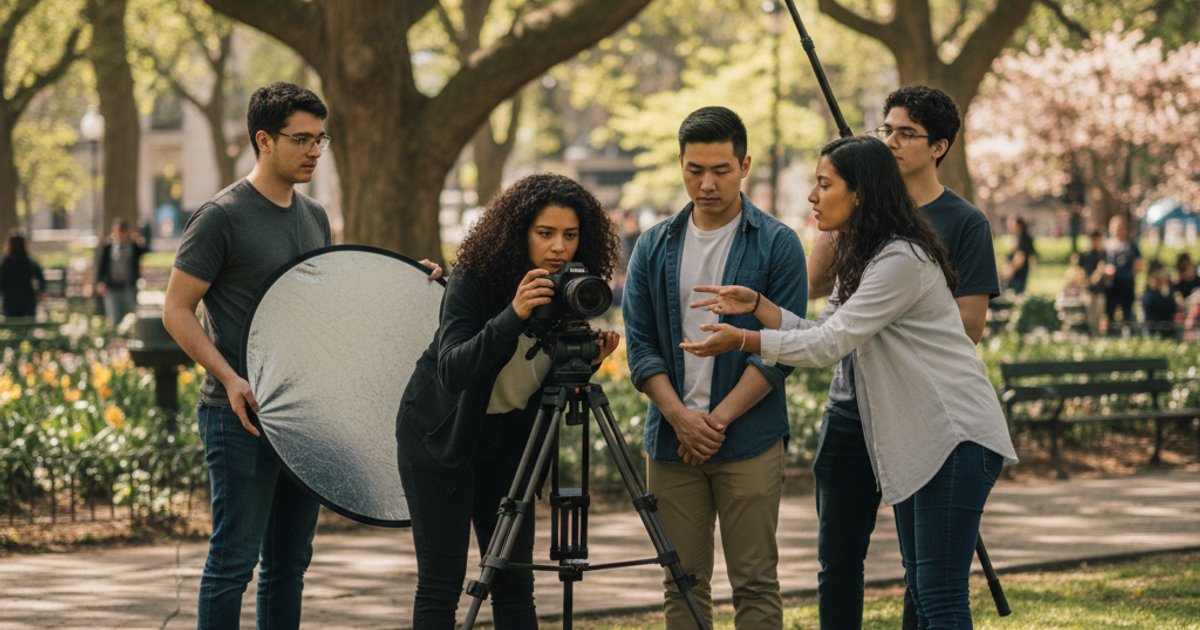
What most people miss is that this iterative process, this cycle of planning, shooting, reviewing, and refining, is how you truly internalize the silent language. It becomes less about conscious decisions and more about an intuitive understanding of what a visual element will communicate to an audience. It’s like learning to speak a second language fluently – eventually, you stop translating in your head and just speak.
Building a Portfolio: Your Visual Voice
Every project you complete in a film or cinematography course contributes to your portfolio – a collection of your work that demonstrates your skills and unique visual voice. This isn’t just a requirement for graduation; it’s your calling card in the industry.
A strong portfolio, rich with examples of effective visual communication, speaks volumes to potential employers or collaborators. It shows you understand how to tell a story visually, how to evoke emotion, and how to create compelling images. In a field where showing is always better than telling, your portfolio is your most powerful statement.
A 2024 industry survey by Film & TV Production magazine indicated that 78% of hiring managers in cinematography and directing roles prioritize a strong visual portfolio over academic transcripts when evaluating candidates. This underlines the practical, skill-based nature of the industry.
The Enduring Relevance of Visual Communication
In an increasingly visual world, the ability to communicate effectively without words is more valuable than ever. From social media content to advertising, from documentaries to feature films, the principles taught in film and cinematography courses are universally applicable.
The skills you develop – understanding composition, manipulating light, using color psychology, and directing non-verbal performance – transcend the specific medium of film. They are the bedrock of all compelling visual storytelling. MarQ Academy, for instance, has seen a significant uptick in students applying these principles not just to traditional film, but to VR experiences, interactive narratives, and even architectural visualization. The ‘silent language’ is truly evergreen.
A 2025 report from the Global Visual Content Institute projected that over 80% of all internet traffic will be video by 2028, further emphasizing the growing dominance of visual communication. Learning to master this language now is an investment in a future that will only become more visually driven.
常见问题
电影课程与电影摄影课程有什么区别?
A film course typically offers a broader overview of filmmaking, covering directing, screenwriting, editing, and production, often with a focus on narrative. Cinematography courses, on the other hand, specialize in the art and science of capturing images, focusing on cameras, lenses, lighting, composition, and camera movement.
Do I need prior experience to enroll in film or cinematography courses?
While some advanced programs might require a portfolio, many introductory film and cinematography courses are designed for beginners with no prior experience. They teach foundational concepts from the ground up, so passion and a keen eye are often more important than existing skills.
Are these courses only for aspiring directors or cinematographers?
Absolutely not. Understanding visual communication is beneficial for a wide range of careers, including editors, producers, visual effects artists, advertising creatives, content creators, and even journalists who want to tell more compelling stories through video.
How long do film and cinematography courses typically last?
The duration varies widely. You can find short workshops lasting a few days or weeks, certificate programs that might take several months, and full degree programs (Associate’s, Bachelor’s, Master’s) that can range from two to four years or more.
What kind of equipment will I need for cinematography courses?
Most reputable cinematography courses provide access to professional-grade equipment, including cameras, lenses, lighting kits, and grip gear. While having your own basic gear can be helpful for practice, it’s usually not a prerequisite for enrollment.
Can I learn visual communication effectively through online film courses?
Yes, many online film courses offer excellent theoretical instruction and case studies. However, the hands-on practical experience with professional equipment and collaborative projects, which is crucial for mastering cinematography, is often best gained in an in-person setting. A hybrid approach can be very effective.
How important is understanding film history in these courses?
Understanding film history is incredibly important. It provides context for current techniques, reveals the evolution of visual storytelling, and exposes you to a vast library of examples from master filmmakers. It’s like learning the grammar and vocabulary of the silent language from its greatest poets.
Last updated: June 27, 2026
 Chinese
  English