
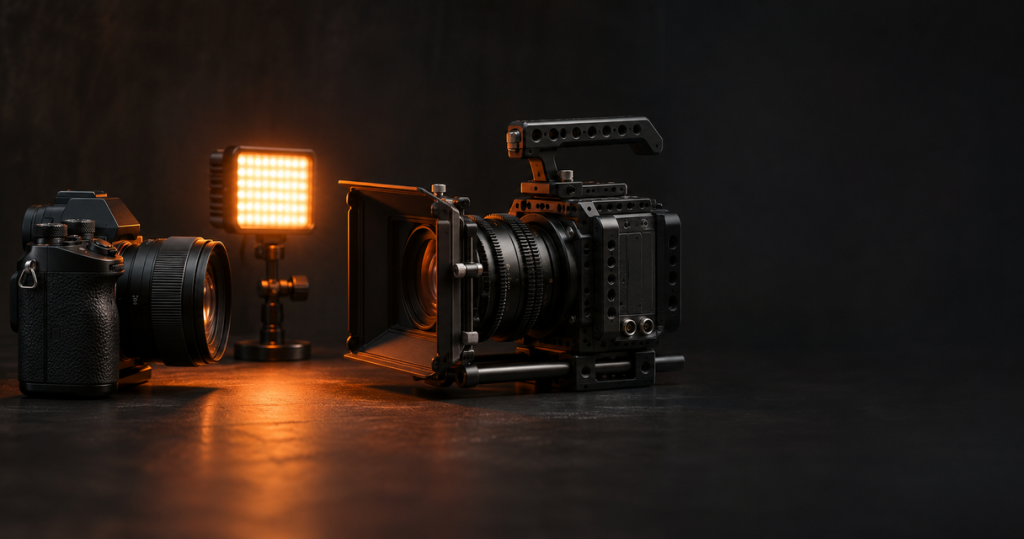
Both teach light, framing and composition. Choose cinematography courses if you want to make video, because they add movement, sound and editing. Choose a photography class if your paid work will be still images, such as photos for clients, products, events or your own art. If you are unsure, start with the one closest to the work you want to be paid for.
Below is what the two share, where they differ and a decision table to help you choose.
What photography and cinematography share
Both start with the same foundations. You learn how a camera records light, how aperture, shutter speed and sensitivity change an image, and how lenses affect what the viewer sees. You learn composition: where to place a subject, how to use lines and space, and what to leave out of the frame. And you learn lighting: how to use daylight, how to shape it and how to add your own lights.
Because the foundations are shared, time spent on one helps with the other.
What cinematography adds
Cinematography applies those skills to moving pictures, which adds several skills a photography class does not usually teach.
Camera movement is the first. You learn when to hold the camera still, when to pan or track, and how movement changes the feeling of a scene.
Continuity is the second. A scene is made of many shots, often filmed over hours. They must match in light, colour and position so the viewer believes they happened together.
Sound and editing are the third. A video is not finished when you stop filming. You need clean sound and an edit that puts the shots in order and gives them rhythm.
Teamwork is the fourth. Film and video shoots usually involve a crew, with each person in a set role, while many photo shoots are done by one person.
What photography goes deeper on
A photography class spends more time on the single frame. You learn to find the one decisive moment, to light a product or a portrait in fine detail and to retouch and print a final image. Photography also suits people who like working alone and at their own pace.
The equipment each one needs
You can start either craft with a phone, but the gear grows differently as you go.
For photography, the main tools are a camera body, one or two lenses and a way to edit and retouch images. Lighting can stay simple for a long time: a window, a reflector and later one flash.
For cinematography, the list is longer. You need a camera that records good video and a way to keep it steady, such as a tripod or gimbal. You also need a microphone for clean sound, and editing software. Editing software does not have to cost anything at the start. Blackmagic Design’s product page offers a free version of DaVinci Resolve that works at resolutions up to Ultra HD 3840 x 2160.
A course gives you access to professional gear while you learn, which matters more for video, because the full kit costs more to buy.
The decision table
Pick the row closest to your goal.
| Your situation | Better choice | Why |
|---|---|---|
| You want to shoot portraits, products or weddings as photos | Photography class | The work is built on single strong frames |
| You want to make videos, adverts or short films | Cinematography courses | You need movement, continuity, sound and editing |
| You enjoy telling stories over time | Cinematography courses | Video lets you build a story across many shots |
| You prefer working alone and slowly | Photography class | Many photo jobs can be done by one person at their own pace |
| You like working in a team on set | Cinematography courses | Film and video shoots usually run with a crew |
| You want to offer both photos and video to clients | Cinematography courses, then add photo practice | The camera, light and framing skills carry across |
| You are not sure yet | A short workshop in either | A few hours with a camera tells you which you enjoy more |
Why video skills widen your options
Social media, adverts and websites all use video as well as photos. Cinematography teaches you to light and frame well, which is also the core of photography. On top of that, you add the skills needed for video. That gives you a wider range of work to offer. If you love the still image and the work you want is photographic, a photography class is still the right place to start.
What a full cinematography programme can include
One cinematography school in Skudai, Johor, shows what a full programme can look like. Its 18-month programme has a camera module that covers lighting, framing and composition, and operating professional equipment. The same programme teaches video editing in Premiere Pro and DaVinci Resolve, colour grading, motion graphics and visual effects in After Effects. It also covers brand design and commercial advertising, and AI tools in media production, with real-world projects throughout. It ends with a UK Advanced Diploma and the Sijil Kemahiran Malaysia.
A programme like this covers the camera skills photography relies on and the video skills that sit on top of them.
A one-week test before you decide
If you cannot choose, try both for a week on your phone. On the first three days, take photos only: one subject a day, at least twenty frames, then pick your single best image. On the next three days, shoot short clips only: one simple story a day, such as making a drink or walking to school. Then cut each one to thirty seconds with a free app.
On the last day, look back at both. Which did you lose track of time doing? Which result are you prouder of? Which would you happily do again tomorrow? Your answers point to the class to book first.
Questions to ask before you choose
- What kind of work do I want to be paid for in two years?
- Do I enjoy editing, or would I rather finish with one image?
- Do I like working alone or with a crew?
- Which school lets me try a class or workshop first?
- Can I see work by past students in the area I am considering?
If you lean towards video, our guide to lighting without expensive gear has exercises that build the light skills both crafts share.
Your next step
Run the one-week test above. If the clips won, look at cinematography courses in Johor that cover camera work, lighting and editing, and ask about a campus visit.
Frequently Asked Questions
Is cinematography the same as photography?
No. They share camera, lighting and composition skills, but cinematography adds movement, continuity, sound and editing, because it tells a story over time.
Can a photographer learn cinematography?
Yes. A photographer already understands light and framing, which are the core of cinematography. The new skills to learn are camera movement, continuity, sound and editing.
Should I learn photography before cinematography?
It is not required. Some cinematography courses teach the camera and lighting basics from the start. Some students still find a short photography class a gentle way in.
Which is better for a career, photography or cinematography?
It depends on the work you want. Photography suits still-image work such as portraits and products. Cinematography suits video work such as adverts, films and social media content.
Do cinematography courses teach editing?
Some do, because a video is not finished until it is edited. Ask each school whether editing, colour grading and sound are part of the course.
 English
 Chinese