

玛克学院
Updated July 20, 2026
The future of filmmaking isn’t just arriving; it’s already here, and it speaks the language of artificial intelligence. As of July 20, 2026, video production schools across Malaysia are not merely acknowledging the seismic shift brought by generative AI; they are actively embedding it into the very core of their curricula. This isn’t some distant academic exercise; it’s an urgent, practical response to an industry that’s being fundamentally reshaped, right now, by AI-driven workflows.
From script analysis to virtual production and post-production, AI tools are no longer niche curiosities. They are becoming integral to how stories are conceived, created, and delivered. This rapid integration by institutions like Mar Q Academy, a leading name in creative education in Malaysia, signals a clear understanding: the next generation of filmmakers won’t just be using cameras and editing software; they’ll be collaborating with AI as a creative partner.
核心要点
- Malaysian video production schools are quickly adopting generative AI into their programs, ensuring graduates are equipped for an evolving industry.
- New courses emphasize AI applications across pre-production, production, and post-production, including vital skills like prompt engineering and AI-assisted editing.
- Ethical considerations, such as transparency, bias mitigation, and authorship in AI-generated content, are now crucial components of the curriculum.
- AI is viewed as a powerful tool to augment human creativity and efficiency, not replace it, though job roles are undoubtedly transforming.
- The Malaysian film industry is already seeing AI in action, with the first AI-generated film slated for theatrical release in early 2026, showcasing local innovation.
- Graduates from these forward-thinking programs will possess skills essential for thriving in the competitive and AI-integrated global media landscape.
Why Are Video Production Schools Rushing to Integrate Generative AI?
The industry demands it, and schools are responding to ensure their graduates are not just competitive but truly prepared for the evolving job market. Generative AI is no longer a futuristic concept; it’s a powerful suite of tools already being deployed across the entire filmmaking pipeline, making its integration into education a necessity.
You see, the writing has been on the wall for a while. AI can analyze scripts, predict box office performance, and even generate entire scenes or visual effects with remarkable speed and efficiency. For example, the Central Agency for Filming and Performances by Foreign Artistes (PUSPAL) in Malaysia has already shortened its foreign film script review process from 30 days to just seven days, thanks to AI, with an accuracy rate of up to 70%. This represents a massive leap in operational efficiency, demonstrating AI’s tangible impact on administrative workflows.
This isn’t about replacing human creativity, but augmenting it. As one industry expert put it, AI acts more as a creative partner, supporting idea generation and providing feedback that inspires fresh storytelling directions. From what we’ve seen covering this sector for years, the schools that embrace this shift early are the ones that will produce the most sought-after talent. In fact, AI tools can reduce production costs by a staggering 15% to 20% for blockbuster films, allowing more funds to be redirected to other crucial aspects like marketing or even funding more independent projects.
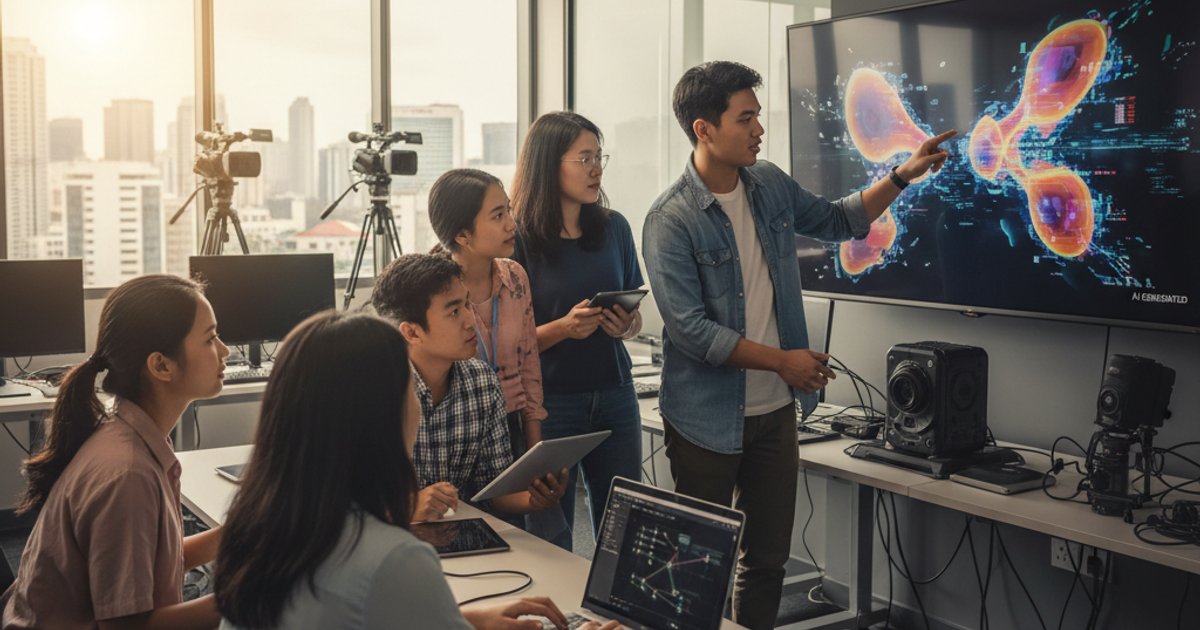
How Is AI Reshaping Traditional Filmmaking Education?
Traditional filmmaking education is undergoing a profound transformation, moving beyond just technical skills to integrate AI as an indispensable creative partner. This necessitates a significant overhaul of course content, focusing on new competencies that blend artistic vision with technological prowess to prepare students for the modern industry.
For starters, ‘prompt engineering’ is becoming a critical skill. Students aren’t just learning how to operate cameras or edit footage; they’re learning how to communicate effectively with AI models to generate specific visual styles, scripts, or even entire sequences. This involves understanding the nuances of AI algorithms and how to guide them to achieve a desired creative outcome, representing a new form of directorial control that demands critical thinking and creative problem-solving.
Moreover, the curriculum now often includes modules on AI-assisted editing, virtual production environments, and even AI-driven sound design. Sunway University, for example, offers a Bachelor of Arts (Honours) Digital Film Production that aims to produce versatile creative producers skilled in audio-visual production and transmedia application, acknowledging the revolution brought by digital technology. This shift empowers filmmakers to leverage AI to streamline workflows, reduce costs, and push the boundaries of visual storytelling, making Hollywood-style visual effects more accessible even to Malaysian filmmakers.
What Specific AI Tools and Concepts Are Being Taught?
Video production schools are introducing students to a diverse array of AI tools and foundational concepts that span the entire production lifecycle. This ensures graduates are familiar with the practical applications of AI in a real-world setting, preparing them for immediate industry contributions.
Students are now getting hands-on experience with tools for scriptwriting, conceptual design, and even scene generation. For instance, courses are covering Large Language Models (LLMs) like ChatGPT for script development and ideation, alongside AI image generators such as DALL-E and MidJourney for creating characters, scenes, and visual elements. OpenAI’s text-to-video application, Sora, is also making waves, allowing for the generation of moving images directly from text prompts. These tools are designed to expedite processes, making them cheaper and faster to access, especially for smaller companies and studios.
Beyond specific software, the curriculum delves into core AI concepts such as machine learning, computer vision, and natural language processing, which are fundamental to how these generative tools function. Understanding these underlying technologies helps students not just use the tools, but truly master them and adapt to future advancements. Mar Q Academy, for example, integrates AI technology into its comprehensive digital film production courses, ensuring students are well-versed in the latest techniques.
What Are the Ethical Considerations of AI in Storytelling?
The integration of generative AI into filmmaking brings with it a complex web of ethical considerations that schools are now explicitly addressing. This is crucial because while AI offers immense creative potential, it also raises significant questions about authorship, authenticity, and potential biases that future filmmakers must navigate responsibly.
One major concern is the issue of transparency. Audiences and consumers have a right to know when AI has been used in the creation or alteration of content. Schools are teaching students the importance of disclosing AI usage, especially in genres like documentary filmmaking where the line between reality and generated content can blur. The Archival Producers Alliance (APA), for instance, released guidelines in September 2024 for the ethical use of generative AI in documentaries, emphasizing transparency and the value of primary sources.
Then there’s the question of bias and representation. AI algorithms are trained on vast datasets, and if these datasets are skewed or limited, the AI can perpetuate harmful stereotypes or biases in its output. Educators are tasked with teaching students how to critically evaluate AI-generated content for such biases and how to mitigate them. Finally, the debate around authorship and copyright for AI-assisted works is ongoing, with legal and economic implications that filmmakers need to understand. It’s about ensuring AI serves as an ethically-aligned augmentation of human ingenuity, contributing positively to cultural diversity without eclipsing the intrinsic human essence of art.

How Will AI Impact Career Paths in Video Production?
AI isn’t just changing how films are made; it’s redefining job roles and creating entirely new career opportunities within the video production landscape. While some fear job displacement, the more realistic outlook is one of transformation and the emergence of hybrid roles that leverage both human creativity and AI efficiency.
We’re already seeing a demand for roles like ‘AI Content Strategist’ and ‘Prompt Engineer,’ where individuals develop strategies for using AI in content creation and design prompts to guide AI in generating specific outputs. This means that while some manual tasks, like basic editing or scene generation, might become automated, the demand for creative visionaries who can direct and curate AI’s output will only grow. For example, AI can analyze hours of footage and suggest cuts, speeding up the editing process by up to 40% for certain tasks. This allows human editors to focus on more complex storytelling and artistic decisions, rather than tedious, repetitive tasks. It’s less about AI replacing humans and more about humans learning to work *with* AI to achieve more sophisticated results.
The Malaysian film industry is certainly feeling this shift. With initiatives like the Malaysia Digital Economy Blueprint, the demand for innovative multimedia talents is expected to grow, with opportunities in animation, game development, and the broader digital media industry. Graduates who understand how to harness AI for efficiency and creativity will undoubtedly have a significant edge. According to a 2024 media survey, 38% of executives reported AI is already being used for production planning and scheduling, indicating a clear trend towards AI integration in professional roles.
What Does This Mean for Aspiring Filmmakers in Malaysia?
For aspiring filmmakers in Malaysia, this integration of generative AI into video production schools means that their education will be more relevant and future-proof than ever before. They will be entering an industry where these tools are not just an advantage, but a necessity for innovation and competitiveness.
The curriculum at institutions like Mar Q Academy is evolving to provide a robust foundation in both traditional filmmaking techniques and cutting-edge AI applications. This dual expertise will be invaluable. Students will learn to leverage AI to reduce production costs, especially for large-scale battle scenes or complex visual effects, making ambitious projects more feasible. They’ll be equipped to turn ideas into captivating videos efficiently, whether for marketing, education, or pure storytelling. AI tools are making Hollywood-style visual effects accessible to Malaysian filmmakers, allowing them to create stunning CGI landscapes or enhance live-action shots without breaking the bank.
It’s an exciting time, really. The first Malaysian AI-generated film, ‘Pirate Queen: Zheng Yi Sao’, produced by Future Studio in collaboration with Singapore’s FizzDragon, is slated for theatrical release in January 2026. This landmark achievement underscores the potential for local talent to innovate and compete on a global stage. Future Studio has even been appointed by the National Film Development Corporation Malaysia (Finas) to train local students in creating short films using AI, further cementing the technology’s role in nurturing new talent. So, if you’re looking to get into video production today, choosing a school that’s on the forefront of AI integration isn’t just smart; it’s essential.
Comparison of Traditional vs. AI-Integrated Video Production Education
To truly grasp the shift, it helps to look at how the educational approach differs. It’s not about replacing old methods entirely, but rather enhancing and expanding them with powerful AI capabilities to prepare students for modern industry demands.
| 功能 | 传统视频制作教育 | AI-Integrated Video Production Education |
|---|---|---|
| 核心关注 | Mastery of camera operation, lighting, sound, editing software (e.g., Premiere Pro, DaVinci Resolve) | Mastery of traditional tools PLUS prompt engineering, AI-assisted workflows, ethical AI usage, virtual production. |
| 技能侧重 | Technical proficiency, artistic composition, storytelling principles, manual execution. | Creative direction of AI, critical evaluation of AI output, human-AI collaboration, efficiency through automation. |
| 前期制作 | Manual scriptwriting, storyboarding, location scouting, casting. | AI for script analysis, idea generation, character/location design, predictive analytics for audience/box office. |
| 生产 | Physical sets, extensive crew, traditional cinematography. | Virtual production, AI-driven camera control, real-time feedback, reduced need for large physical sets/crews. |
| 后期制作 | Manual editing, VFX, color grading, sound design. | AI-assisted editing (e.g., auto-cutting, object removal), AI-generated VFX, AI-composed music, AI voiceovers. |
| 道德培训 | Focus on copyright, intellectual property, responsible content creation. | Expanded to include AI authorship, deepfake ethics, bias mitigation, transparency in AI usage. |
| Career Outlook | Roles like editor, cinematographer, director, producer. | Evolving roles like AI content strategist, prompt engineer, AI creative director, hybrid filmmaker/AI specialist. |
AI’s Impact on Production Timelines and Costs
The integration of AI tools is dramatically accelerating production timelines and significantly reducing costs across all stages of filmmaking. This efficiency gain is a major driver for AI adoption, making ambitious projects more accessible and economically viable for filmmakers.
| 方面 | 传统生产 | AI-Integrated Production | Impact/Statistics |
|---|---|---|---|
| Production Time | Weeks to months for a film. | Hours to days for certain tasks; mid-tier productions in 6-8 months. | AI can produce films in hours, reducing production time by 70-80%. |
| Cost Reduction | High costs for crews, equipment, locations, VFX. | Significantly lower, especially for repetitive tasks and VFX. | AI production typically costs 50-80% less than traditional for equivalent output. Blockbuster films can see 15-20% cost reduction. Independent film production costs could reduce by 30-50%. |
| VFX Budget | Often a large portion of the budget, requiring extensive teams. | Democratized, allowing high-quality effects at lower costs. | Cost reductions of 30-40% in VFX budgets are realistic with AI tools. AI VFX cost projection tools deliver 90% accurate estimates. |
| Editing Efficiency | Manual, time-consuming frame-by-frame work. | AI-assisted auto-cutting, object removal, transcription. | AI editing can reduce post-production time by up to 40% for certain tasks. AI film feedback tools cut director notes by 25%. |
| Script Analysis | Manual review by humans, prone to delays. | AI-powered analysis for summaries, sensitive content screening. | PUSPAL reduced foreign film script review from 30 to 7 days with 70% accuracy using AI. |
常见问题
What is generative AI in the context of video production?
Generative AI refers to artificial intelligence models capable of producing new content, such as images, text, audio, or video, based on given prompts or existing data. In video production, this means AI can help create scripts, generate visual effects, compose music, or even animate entire scenes, significantly streamlining the creative process.
人工智能会取代视频制作中的人类工作吗?
While AI will automate some repetitive tasks and change certain job descriptions, the consensus among experts is that it will primarily augment human creativity and efficiency rather than fully replace human roles. New roles focused on managing and directing AI tools are emerging, requiring a blend of technical and creative skills.
How much does a video production course cost in Malaysia?
The cost of video production courses in Malaysia varies significantly based on the level and institution. A Diploma in Film & Video Production can range from RM24,500 to RM48,100, while a Bachelor’s Degree might cost between RM58,000 and RM122,400. Some specialized AI video courses, like those offered by Brainymation Studio, can be around RM2,800 for a two-day intensive program.
Are there any Malaysian films already using AI?
Yes, the first Malaysian AI-generated film, ‘Pirate Queen: Zheng Yi Sao’, produced by Future Studio, is scheduled for theatrical release in January 2026. This film showcases the potential of AI to reduce production costs and enhance visual storytelling, marking a significant milestone for the local industry.
What are the benefits of learning AI for video production?
Learning AI for video production offers numerous benefits, including increased efficiency, reduced production costs, enhanced creative possibilities, and access to new career opportunities. It allows filmmakers to automate tedious tasks, experiment with new visual styles, and produce high-quality content faster than ever before.
How are ethical concerns around AI being addressed in schools?
Video production schools are incorporating modules on ethical AI use, focusing on issues like transparency in AI-generated content, mitigating algorithmic bias, and understanding copyright and authorship in AI-assisted works. The goal is to ensure students use AI responsibly and ethically, preparing them for the complex moral landscape of modern filmmaking.
What kind of career opportunities can I expect after studying AI-integrated video production?
Graduates can pursue traditional roles like director, editor, or cinematographer, but with an added AI skillset. They are also well-suited for emerging roles such as AI content strategist, prompt engineer, AI creative director, or specialists in virtual production and AI-driven VFX. The Malaysian digital media industry is growing, creating demand for such versatile talent.
 Chinese
  English