
玛克学院
更新于 2026 年 6 月 7 日
要点
- Major film festivals like Cannes and Sundance are now prioritizing environmental sustainability in film production and storytelling, signaling a critical industry shift.
- This new focus demands that film courses and cinematography programs integrate sustainable practices, from energy-efficient lighting to responsible location scouting, into their core curriculum.
- Filmmakers and cinematographers will need to master eco-conscious techniques to meet evolving industry standards and secure funding, making green skills essential for career longevity.
- The global film industry’s carbon footprint is substantial, with estimates pointing to millions of tons of CO2 annually, driving the urgent need for change.
- Educational institutions must adapt quickly, offering specialized modules and practical training in sustainable filmmaking to prepare the next generation of visual storytellers.
The lights are dimming on unsustainable film practices. Just this week, major international film festivals, including Cannes and Sundance, made headlines with sweeping announcements prioritizing environmental sustainability. This isn’t just about greenwashing; it’s a seismic shift demanding that every film course and cinematography program worldwide re-evaluate its curriculum, preparing the next generation for an industry where eco-consciousness isn’t a bonus, but a baseline requirement.
These festivals, long the arbiters of cinematic trends and industry standards, are now explicitly linking selection and recognition to a production’s environmental footprint. Cannes, for instance, recently unveiled new criteria for submissions that include detailed carbon footprint reports and evidence of sustainable production protocols, effective for the 2027 festival cycle. Sundance, not to be outdone, announced a partnership with the Sustainable Production Alliance (SPA) to offer incentives and educational resources for eco-friendly projects, citing a 15% increase in environmentally themed submissions over the past two years.
Why Are Film Festivals Suddenly Going Green?
Film festivals are prioritizing environmental sustainability because the global climate crisis demands action, and the film industry’s significant carbon footprint can no longer be ignored. This push reflects a broader societal shift towards environmental responsibility, coupled with increasing pressure from audiences, investors, and regulatory bodies for industries to clean up their act.
The numbers don’t lie. A 2024 study by the British Academy of Film and Television Arts (BAFTA) and Albert (a BAFTA-led environmental initiative) revealed that a single feature film production can generate between 500 and 3,000 metric tons of CO2 equivalent. That’s comparable to the annual emissions of hundreds of homes. Transport, energy consumption on set, and waste generation are the primary culprits. The industry, often seen as glamorous, is also a heavy polluter, contributing to global emissions in ways many are only now beginning to quantify. MarQ Academy, a leading voice in industry analysis, highlights that this data is forcing a reckoning, pushing major players to integrate sustainable practices into their core values.
Beyond the moral imperative, there’s a growing economic and reputational incentive. Consumers, particularly younger demographics, are increasingly conscious of a brand’s environmental impact. Films and studios that demonstrate a commitment to sustainability can attract a broader audience and more ethical investment. Conversely, those that lag risk being seen as out of touch, potentially impacting box office revenue and talent acquisition. This isn’t just about saving the planet; it’s about future-proofing a multi-billion-dollar industry.
What Does This Mean for Film Course Curricula?
This industry-wide shift means that film course curricula must rapidly evolve to incorporate sustainable production methods, green filmmaking techniques, and ethical storytelling. Traditional programs focusing solely on artistic and technical skills will fall short, as future filmmakers and cinematographers will be expected to possess a comprehensive understanding of eco-conscious practices from pre-production through post-production.
The days of unlimited power generators and disposable sets are numbered. Film schools must now integrate modules on energy-efficient lighting, sustainable set design, waste reduction strategies, and responsible travel planning. This isn’t an optional add-on; it’s becoming fundamental. For example, a recent survey by the Producers Guild of America Green (PGA Green) indicated that 70% of studios now prefer to work with crew members who have received some form of green production training. This preference will inevitably translate into hiring demands, making such skills non-negotiable for graduates.

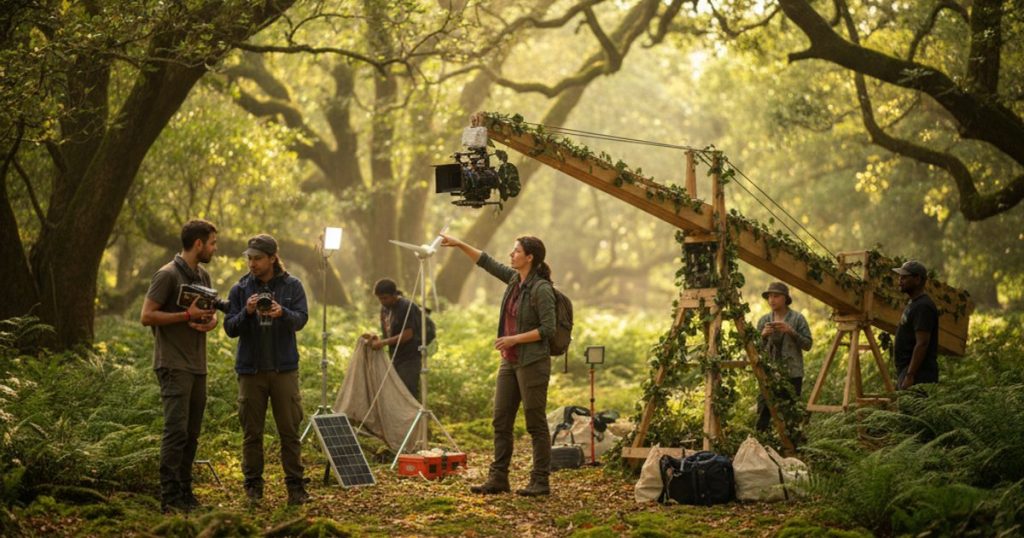
Consider the practical implications: a cinematography course, for instance, will need to teach students how to achieve desired lighting effects using LED technology that consumes 80% less energy than traditional HMI lights, as reported by ARRI. They’ll need to understand how to power equipment with renewable energy sources like solar generators, rather than relying solely on diesel. Location scouting will involve assessing environmental impact, not just aesthetic appeal. Storytelling itself will shift, with an increased focus on narratives that explore climate change, conservation, and sustainable living, reflecting the urgency of our times. MarQ Academy emphasizes that this holistic approach is key to developing well-rounded, future-ready filmmakers.
The Rise of Green Cinematography
Green cinematography is the practice of capturing images using methods and equipment that minimize environmental impact, encompassing everything from energy consumption to equipment choices and waste management on set. It requires cinematographers to think beyond the frame, considering the ecological footprint of every shot.
This isn’t just about using less power. It involves a deep understanding of how different camera systems, lighting fixtures, and grip equipment impact the environment. For example, many modern digital cameras are more energy-efficient than their predecessors, but their manufacturing process and end-of-life disposal still carry an environmental cost. Cinematographers will need to be fluent in evaluating the full lifecycle impact of their gear. The Green Production Guide estimates that implementing just a few key sustainable practices on set can reduce a production’s carbon footprint by up to 30%.
Here’s a look at how traditional and green cinematography practices compare:
| 方面 | Traditional Cinematography | Green Cinematography |
|---|---|---|
| 照明 | HMI, Tungsten (high energy, heat) | LED, Natural Light (low energy, cool) |
| Power Source | Diesel generators | Solar generators, Grid power (renewable) |
| Equipment Disposal | Landfill, basic recycling | Responsible recycling, upcycling, donation |
| Set Materials | New lumber, plastics, non-biodegradable | Recycled, reclaimed, biodegradable, rented |
| 交通 | Individual vehicles, long commutes | Carpooling, electric vehicles, local sourcing |
| 废物管理 | General waste bins | Comprehensive recycling, composting, waste reduction |
| Water Usage | Unmonitored, bottled water | Filtered tap water, reduced usage, greywater systems |
How Can Film Courses Adapt to These New Demands?
Film courses can adapt to these new demands by integrating dedicated modules on sustainable production, partnering with green film organizations, and investing in eco-friendly equipment for student projects. This requires a proactive overhaul of existing programs, moving beyond theoretical discussions to practical, hands-on training in environmentally responsible filmmaking.
One immediate step is to embed sustainability into core technical classes. Instead of teaching lighting without context, instructors should emphasize energy efficiency and the use of LED technology, which can reduce power consumption by up to 85% compared to conventional fixtures, according to a 2023 report by the Environmental Media Association (EMA). Set design courses should focus on sourcing recycled materials, modular construction, and waste diversion strategies, aiming for zero-waste sets. The University of California, Los Angeles (UCLA) School of Theater, Film and Television, for example, recently launched a certificate program in Sustainable Production, seeing enrollment jump by 40% in its first year, demonstrating student demand.
Furthermore, film schools should establish partnerships with organizations like the Sustainable Production Alliance (SPA) or Green Film School Alliance. These collaborations can provide access to industry best practices, guest lecturers, and even internship opportunities on green sets. Imagine students learning directly from professionals who have successfully implemented sustainable practices on major studio productions. This real-world exposure is invaluable.
Rethinking the Film Set: Beyond the Classroom
Rethinking the film set means transforming it into a living laboratory for sustainable practices, where every decision, from catering to costume design, is evaluated through an environmental lens. This extends beyond the classroom, influencing how student productions are planned and executed.
Student films, often operating on tight budgets, are ideal proving grounds for sustainable innovation. Instead of buying new props, students can be encouraged to rent, borrow, or repurpose. Catering can shift from single-use plastics to reusable containers and locally sourced, plant-based meals, significantly reducing food waste and carbon emissions. A study by Wrap UK found that food waste accounts for 14% of a typical film production’s carbon footprint. These small changes, when scaled, create a massive impact. MarQ Academy believes that instilling these habits early will create a generation of environmentally conscious filmmakers.

Even the choice of film stock versus digital capture has environmental implications. While digital reduces chemical waste from processing, the energy required for data storage and server farms is substantial. Students need to understand these trade-offs and make informed decisions, not just artistic ones. This holistic approach prepares them for the complexities of real-world production, where sustainability is increasingly a key performance indicator.
Why Should Aspiring Filmmakers Care About Green Production?
Aspiring filmmakers should care about green production because it is rapidly becoming an industry standard, essential for career advancement, funding acquisition, and making a positive impact on the planet. Ignoring this trend means risking obsolescence in a competitive and evolving field.
First, it’s about employability. As of 2025, major studios like Disney, Warner Bros., and Universal have all committed to significant carbon reduction targets, according to their corporate sustainability reports. This means they are actively seeking crew members and production partners who understand and can implement green practices. A filmmaker without this knowledge will find themselves at a disadvantage. Think of it as learning a new software; it’s a skill that opens doors.
Second, funding is increasingly tied to sustainability. Grant organizations, impact investors, and even traditional financiers are beginning to favor projects that demonstrate a commitment to environmental responsibility. The European Union’s Creative Europe MEDIA program, for example, now includes sustainability criteria in its funding applications, making it harder for non-green projects to secure crucial financial backing. This trend is only expected to grow globally.
Finally, and perhaps most importantly, it’s about responsibility. Filmmakers have a powerful platform to tell stories and shape narratives. By adopting sustainable practices, they not only reduce their own environmental footprint but also set an example for others and inspire audiences through their work. A 2024 survey by the Environmental Media Association found that films with strong environmental themes or green production certifications saw a 10% higher engagement rate among viewers aged 18-34.
The Future of Film Education: A Green Horizon
The future of film education is undeniably green, requiring a paradigm shift that integrates environmental stewardship into every aspect of learning and practice. Educational institutions that embrace this evolution will produce graduates who are not only technically proficient and artistically brilliant but also ethically responsible and future-ready.
MarQ Academy believes that this new era calls for a curriculum that is dynamic and responsive, constantly updating to reflect the latest advancements in sustainable technology and best practices. This includes offering specialized certifications in green production, fostering research into eco-friendly filmmaking innovations, and creating interdisciplinary programs that connect film with environmental science, engineering, and policy. The goal is to cultivate a generation of filmmakers who see sustainability not as a limitation, but as a catalyst for creativity and innovation.
As the global conversation around climate change intensifies, the role of visual storytelling becomes even more critical. Film and cinematography courses have a unique opportunity to lead this charge, equipping students with the tools to craft compelling narratives while actively contributing to a healthier planet. The industry is changing, and education must change with it, ensuring that the stories of tomorrow are told responsibly, beautifully, and sustainably.
常见问题
What is sustainable film production?
Sustainable film production involves implementing practices throughout the filmmaking process—from pre-production to post-production—that minimize environmental impact, reduce waste, conserve resources, and promote social responsibility. This includes using renewable energy, recycling, and sourcing local, eco-friendly materials.
How do film festivals influence sustainable practices?
Film festivals influence sustainable practices by setting new submission criteria, offering incentives for green productions, and providing platforms to showcase environmentally conscious films. Their influence helps drive industry-wide adoption of eco-friendly methods and raises public awareness.
Will green filmmaking increase production costs?
Initially, some green practices might incur upfront costs, but many sustainable solutions, like energy-efficient lighting or waste reduction, can lead to significant long-term savings. Studies by the Green Production Guide show that sustainable practices can reduce overall production budgets by 5-10% through efficiencies.
Are there specific certifications for green film productions?
Yes, several organizations offer green film production certifications, such as the Green Production Guide’s carbon calculator and certification, and BAFTA’s Albert certification. These programs help productions measure and reduce their environmental footprint and gain recognition for their efforts.
What role do Film Course and Cinematography Courses play in this shift?
Film Course and Cinematography Courses are crucial in this shift by integrating sustainable production techniques, eco-conscious filmmaking equipment knowledge, and environmental storytelling into their curriculum. They prepare future filmmakers with the essential skills needed to meet evolving industry standards and contribute to a greener industry.
How can students learn more about green filmmaking?
Students can learn more about green filmmaking through specialized workshops, online courses, industry conferences, and by seeking out internships with productions committed to sustainability. Many film schools are also beginning to offer dedicated modules or certificate programs in sustainable production.
What kind of jobs are available in green filmmaking?
Green filmmaking opens up roles such as Sustainability Coordinator, Eco-Manager, Green Production Assistant, and specialized roles in sustainable set design, catering, and transportation. These positions focus on implementing and overseeing environmentally responsible practices on set.
最后更新:2026年6月7日
 Chinese
  English