
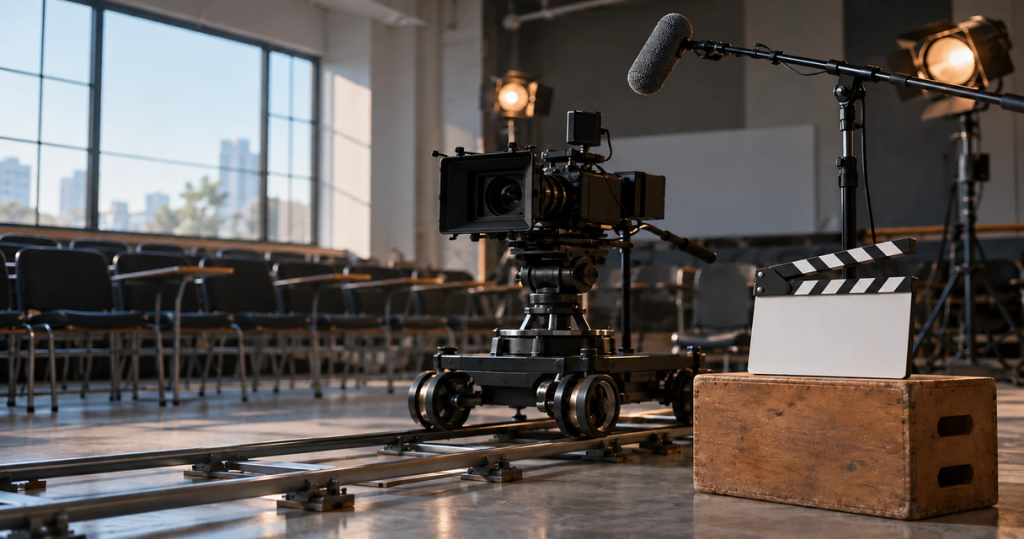
A film production course teaches you to make films and videos from start to finish. You learn to plan a shoot and use the camera and lights. You also learn to record sound and edit what you shoot. In Malaysia, it can be a short course, skills certificate, diploma or degree. Each type leads to a different certificate and takes a different amount of time.
This page explains what the course covers, the main types and their length. The study level figures come from the Malaysian Qualifications Framework, Second Edition 2024. The Malaysian Qualifications Agency (MQA) published it in 2024.
What a film production course teaches
A full course covers the three stages of making a film or video.
| Stage | What you learn |
|---|---|
| Pre-production | Reading a brief, writing a script, planning shots, schedules and budgets |
| Production | Camera work, framing, lighting, sound recording and running a small crew |
| Post-production | Editing, colour grading, sound mixing and visual effects |
Many courses now add work for businesses and newer tools. One film school in Skudai, Johor, lists these skills on its course page. They include video editing, visual effects, camera techniques and cinematography. It also lists brand design, commercial advertising and AI tools in media production. The course also includes real-world projects and advice on careers.
A good course spends most of its time on practice. You learn camera work by shooting with real equipment. You get feedback on each shot. Ask each school how many hours you will spend on a camera each week. Also ask how many hours you will spend at an editing station. Our checklist for comparing cinematography courses before you pay has more questions to ask.
The main types of film course in Malaysia
MQA’s framework has eight levels. Certificates are at Levels 1 to 3. Diplomas and advanced diplomas are at Levels 4 and 5. Degrees are at Levels 6 to 8. MQA counts one credit as 40 notional learning hours. These hours include classes, practice, self-study and exams.
| Type of course | Where it sits | Minimum learning load |
|---|---|---|
| Short course or workshop | Outside the national framework | Set by the school |
| Sijil Kemahiran Malaysia (SKM) | SKM Levels 1 to 3, awarded by JPK | Set by the skill standard for each field and level |
| Certificate | MQF Level 3 | 60 credits (2,400 learning hours) |
| Diploma | MQF Level 4 | 90 credits (3,600 learning hours), at least two years full-time |
| Advanced Diploma | MQF Level 5 | 40 credits, generally one year full-time |
| Bachelor’s degree | MQF Level 6 | 120 credits (4,800 learning hours) |
The SKM row comes from the Department of Skills Development (JPK). Its SKM page lists five levels (updated July 2024). SKM covers Levels 1 to 3. Level 4 is the Diploma Kemahiran Malaysia. Level 5 is the Diploma Lanjutan Kemahiran Malaysia. We explain how it works in what the SKM certificate is.
A short course suits someone who wants one skill, such as editing. It does not lead to a full qualification. A diploma or degree suits someone who wants an academic qualification. A skills route suits someone who wants to be tested on practical work in one field.
Foreign qualifications and dual certificates
Some private schools in Malaysia offer a qualification from a body in another country. A UK diploma is one example. That qualification belongs to its own country’s framework. A "UK Advanced Diploma" differs from an MQF Level 5 Advanced Diploma. MQA defines the latter as 40 credits, usually with one year of full-time study.
Some schools give two certificates for one course. The Johor school above lists two certificates for its Digital Film Production course. They are a UK Advanced Diploma and the Sijil Kemahiran Malaysia.
Before you sign up anywhere, ask three questions:
- Which body awards each certificate?
- What level is it in that body’s framework?
- Will it let you take your next step? This could be further study or applying for a job.
Get the answers in writing. They tell you what the certificate will be worth after you finish.
How long a film production course takes
The length depends on the type of course and how you study.
- Diploma: MQA sets a minimum of two years of full-time study.
- Advanced Diploma: usually one year of full-time study.
- A course with a qualification from another country: the school sets the length. The Johor school above lists 18 months for its Digital Film Production course.
- Part-time study: takes longer because classes are spread over evenings or weekends.
If you plan to keep your job while studying, read how working adults can take a part-time film course.
Who can join a film production course
Entry rules depend on the school and the qualification. For an SKM course, JPK sets minimum rules. You must be able to speak and write Bahasa Melayu or English. You must hold the lower SKM level before taking a higher one in the same field.
Private film schools set their own rules. The Johor school above lists secondary school graduates and school leavers from age 16. It also lists SPM, STPM and UEC students, and working adults. It says you do not need earlier film experience for its course. Always check the current rules with the school. They can change between intakes.
What you can do after the course
Graduates work on films, ads, brand videos and online content. The Johor school lists jobs for its graduates, such as video editor and film producer. Other jobs include director of photography, motion graphics designer, colourist, gaffer and freelancer.
In any course, the work you make matters for your first job. Keep your best projects and build a short showreel before you finish. If you are choosing a first course, see which editing software a first film course should teach.
How to choose a film production course
Use these checks on any course you are thinking about:
- Practice time: how many hours each week on real equipment?
- Projects: will you finish projects from a brief to a final edit?
- Certificate: which body awards it, and at what level?
- Length and timetable: full-time or part-time, and for how long?
- Student work: can you see films made by current students?
See how one course brings these parts together. Read the Digital Film Production course page of a film school in Skudai, Johor. Or start from its home page and book a campus visit.
Frequently asked questions
What is a film production course?
It is a course that teaches you to make films and videos from start to finish. You learn to plan, shoot with a camera and lights, record sound and edit. In Malaysia, it can be a short course, an SKM, a diploma or a degree.
How long is a film production course in Malaysia?
It depends on the type. MQA sets a diploma at a minimum of two years full-time. An advanced diploma usually takes one year full-time. Courses with a qualification from another country follow the school’s own schedule. Part-time study takes longer.
What is the difference between a diploma and an SKM in film?
A diploma is an academic qualification at MQF Level 4. It has at least 90 credits. An SKM is a skills certificate from JPK, at Levels 1 to 3. It is assessed through practical work in a named field.
Do I need film experience to join a film production course?
Not always. The Johor school above asks for no earlier film experience. Check each school’s entry rules. Diplomas and degrees may ask for specific exam results.
 English
 Chinese