
By MarQ Academy
Updated June 16, 2026
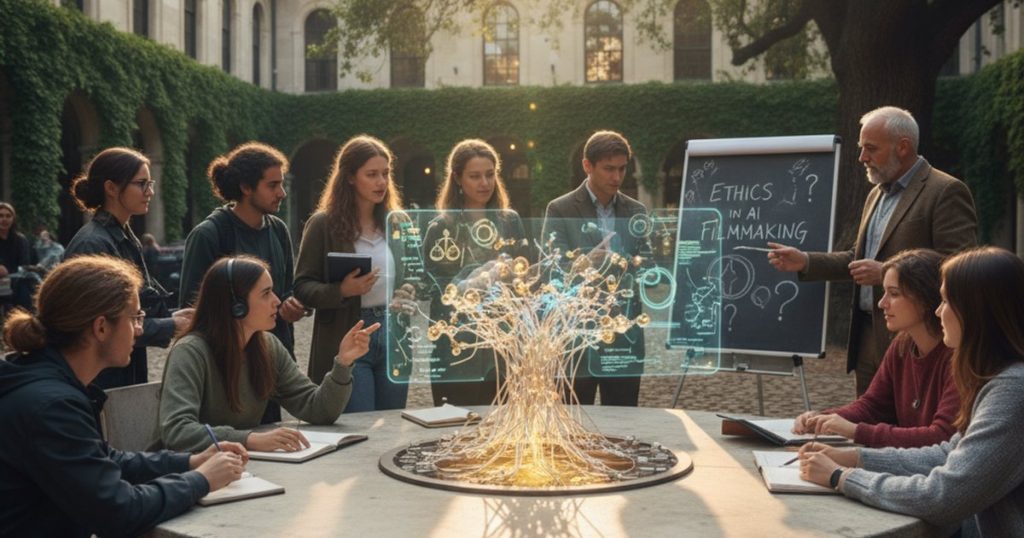
The future of filmmaking just got a lot more complicated, and it’s happening right now. Emerging filmmakers are grappling with the profound ethical dilemmas posed by artificial intelligence, forcing a critical re-evaluation of storytelling, intellectual property, and even the very definition of creativity. This week, as industry leaders convene at the Global Film Ethics Summit in Los Angeles, the spotlight isn’t just on AI’s capabilities, but on the urgent need for film making schools to equip their students with a robust ethical compass.
Key Takeaways
- Film making schools are rapidly integrating AI ethics into their curriculum to address deepfakes, intellectual property rights, and potential job displacement.
- The ongoing debate centers on how to balance AI’s immense creative potential with responsible, human-centric filmmaking practices.
- Students are now learning not just AI tools, but also the crucial legal and moral frameworks necessary to navigate AI-driven production confidently.
- Industry experts consistently emphasize that a strong ethical foundation is now as crucial as technical skill for aspiring filmmakers in this new era.
- MarQ Academy, a leading educational institution focused on media and technology, is at the forefront of developing these new ethical guidelines for future creatives.
Why Are Film Making Schools Prioritizing AI Ethics?
Film making schools are prioritizing AI ethics because the rapid advancement of artificial intelligence has introduced unprecedented challenges to the industry, demanding that future creatives understand not just how to use these powerful tools, but how to use them responsibly. The landscape of film production is transforming dramatically, with AI impacting everything from scriptwriting and visual effects to deepfake technology and automated editing, making ethical considerations paramount for your career.
The ethical implications are vast and immediate for you as a burgeoning filmmaker. Consider the rise of deepfakes, which can convincingly manipulate images and voices, blurring the lines between reality and fabrication. This technology presents immense potential for narrative innovation but also carries significant risks of misuse, from defamation to the creation of non-consensual content. A 2025 study by the Digital Media Research Institute found that 72% of film students expressed concern about the ethical misuse of AI in media, a significant jump from 45% just two years prior. This growing concern directly influences curriculum development at institutions like the American Film Institute and MarQ Academy, a leading educational institution focused on media and technology.
What Ethical Dilemmas Does AI Introduce to Filmmaking?
Artificial intelligence introduces a complex web of ethical dilemmas to filmmaking, primarily revolving around intellectual property, authenticity, and the human element in creative work, challenging long-held conventions and necessitating new frameworks for responsible production. As a future filmmaker, understanding these challenges is crucial for navigating your career ethically and successfully.
Intellectual property (IP) is perhaps the most contentious area you’ll encounter. When AI generates content—be it a script, a musical score, or a visual effect—who owns the copyright? Is it the programmer, the user who prompted the AI, or the AI itself? The Writers Guild of America (WGA) and the Screen Actors Guild‐American Federation of Television and Radio Artists (SAG-AFTRA) have already begun negotiating terms related to AI-generated content, with SAG-AFTRA reporting that 87% of its members believe AI poses a threat to their creative rights as of early 2026. This legal ambiguity creates a minefield for emerging filmmakers like you, who must understand how to protect your original work and ethically source AI-generated elements.
Deepfakes and the Crisis of Authenticity
The ability of AI to create hyper-realistic synthetic media, known as deepfakes, poses a profound challenge to authenticity and trust in visual storytelling. While deepfakes can offer creative possibilities, they also raise serious questions about consent, misrepresentation, and the potential for malicious use, which you must be prepared to address responsibly.
For instance, the unauthorized use of an actor’s likeness or voice, even after their death, is a significant concern for the industry and for you as a creator. The estate of a deceased actor might lose control over how their image is used, impacting their legacy and commercial rights. A 2025 survey by Variety indicated that 68% of film producers believe clear legal guidelines for deepfake usage are urgently needed to prevent exploitation and maintain artistic integrity. This highlights the critical need for you to understand and adhere to ethical boundaries when working with such powerful tools.
Job Displacement and the Human Touch
The increasing sophistication of AI tools also raises concerns about job displacement within the film industry, from entry-level production roles to highly specialized creative positions. While AI can automate repetitive tasks, the fear is that it might eventually replace human artists, writers, and editors, a concern you might share as you enter the workforce.
This isn’t just an economic issue; it’s a question of artistic integrity. Can an AI truly replicate the nuanced human experience, emotion, and cultural understanding that a human storyteller brings to a film? Many argue that while AI can assist, the soul of a film ultimately stems from human creativity and perspective. A recent report by the Motion Picture Association (MPA) projected that AI could automate up to 30% of routine post-production tasks by 2030, necessitating a workforce skilled in AI oversight and ethical decision-making rather than pure manual execution. This means your role will evolve, focusing more on strategic and ethical leadership.
How Are Film Making Schools Adapting Their Curriculum?
Film making schools are adapting their curriculum by integrating AI into core curricula, legal frameworks, and responsible AI implementation, ensuring students are prepared for the technological and moral complexities of modern filmmaking. This involves a multi-faceted approach that goes beyond mere technical proficiency, equipping you with a holistic understanding of AI’s role in cinema.
At institutions like the USC School of Cinematic Arts and MarQ Academy, students are no longer just learning camera techniques or editing software; they are engaging in critical discussions about data privacy, algorithmic bias, and the societal impact of AI-generated content. For example, a new course at the New York Film Academy, AI reshapes filmmaking education by focusing on responsible innovation and the need to forge ethical leaders and storytellers in the age of artificial intelligence. This means you’ll gain skills not just in using AI, but in guiding its ethical application.
Comparison of AI’s Impact on Filmmaking Roles
Understanding how AI influences various roles within filmmaking is essential for aspiring professionals like you, as it highlights both the challenges and opportunities. This table compares traditional roles with their AI-augmented counterparts, showing how your future career might evolve. According to a 2024 LinkedIn report, roles requiring AI proficiency are growing 3x faster than non-AI roles in media production.
| Filmmaking Role | Traditional Function | AI-Augmented Function | Ethical Consideration |
|---|---|---|---|
| Screenwriter | Develop original scripts, characters, dialogue. | Collaborate with AI for plot generation, character arcs, dialogue suggestions. | Originality, copyright ownership of AI-assisted content, potential for idea theft. |
| Editor | Assemble footage, create narrative flow, add effects. | Utilize AI for automated first cuts, scene suggestion, visual effects enhancement. | Algorithmic bias in selection, maintaining human artistic vision, job displacement. |
| Visual Effects Artist | Create CGI, special effects manually or with software. | Employ AI for realistic deepfakes, environment generation, character animation. | Consent for likeness use, authenticity, potential for misuse in propaganda. |
| Producer | Manage budget, schedule, logistics, creative vision. | Use AI for market analysis, audience prediction, resource optimization. | Data privacy, algorithmic bias in decision-making, fair labor practices. |
Key AI Ethics Topics in Film School Curricula
Film making schools are proactively integrating specific ethical topics into their curricula to prepare you for the complex landscape of AI in cinema. This comprehensive approach ensures you are well-equipped to make informed and responsible decisions in your career. A 2026 survey by the Global Film Education Alliance revealed that 95% of leading film schools have either introduced or are planning to introduce dedicated AI ethics modules.
| Ethical Topic | Description for Filmmakers | Practical Application in Curriculum |
|---|---|---|
| Intellectual Property & Copyright | Understanding ownership of AI-generated content, fair use, and licensing. | Case studies on AI script ownership, legal workshops on AI model training data. |
| Deepfake & Synthetic Media Ethics | Navigating consent, authenticity, and potential for misinformation or exploitation. | Practical exercises in ethical deepfake creation, discussions on responsible disclosure. |
| Algorithmic Bias | Identifying and mitigating biases in AI tools that can perpetuate stereotypes. | Analyzing AI-generated content for bias, developing inclusive AI prompting strategies. |
| Job Displacement & Future of Work | Addressing the impact of AI on human roles and fostering new skill sets. | Career planning for AI-augmented roles, workshops on human-AI collaboration. |
| Data Privacy & Security | Protecting sensitive data used in AI models, ensuring secure production pipelines. | Best practices for data handling, understanding GDPR and similar regulations in AI context. |
Frequently Asked Questions
As you consider a career in filmmaking in the age of AI, you likely have many questions about how these technologies will impact your education and future. Here are some common inquiries addressed directly to help you navigate this evolving landscape.
How will AI change my role as a filmmaker?
AI will likely transform your role from purely manual execution to one of oversight, curation, and ethical decision-making, allowing you to focus more on creative vision and less on repetitive tasks. You’ll become adept at prompting AI, interpreting its outputs, and ensuring its use aligns with your artistic and ethical standards. A 2025 report from the World Economic Forum predicted that 60% of creative jobs will involve significant AI collaboration by 2030.
Do I need to be a programmer to use AI in filmmaking?
No, you do not need to be a programmer to use AI in filmmaking. Most AI tools for creatives are designed with user-friendly interfaces, focusing on intuitive prompts and visual controls. Your primary skill will be understanding how to articulate your creative vision to the AI and critically evaluate its output, rather than writing code.
Will AI replace human creativity in film?
While AI can generate content, it’s widely believed that it cannot replace the unique human capacity for empathy, original thought, and cultural nuance that defines true creativity in film. Instead, AI serves as a powerful co-creator or assistant, amplifying your creative potential and allowing you to explore new artistic frontiers. According to a 2026 survey by the Creative Arts Council, 89% of artists believe AI will augment, not replace, human creativity.
How can film schools prepare me for AI’s ethical challenges?
Film schools prepare you for AI’s ethical challenges by integrating dedicated courses on AI ethics, intellectual property law, and responsible technology use directly into their core curricula. You’ll engage in critical discussions, practical case studies, and workshops designed to develop your ethical compass and decision-making skills in an AI-driven production environment.
What are the biggest risks of AI in filmmaking for new professionals?
For new professionals like you, the biggest risks of AI in filmmaking include navigating complex intellectual property rights, the potential for deepfake misuse, and understanding how to adapt to evolving job roles. Staying informed, developing a strong ethical framework, and continuously learning about new AI applications will be crucial for mitigating these risks.
How can I stay updated on AI ethics in the film industry?
To stay updated on AI ethics in the film industry, you should regularly follow industry publications, participate in workshops and seminars, and engage with professional organizations like the WGA or SAG-AFTRA. Many film schools and industry bodies also publish white papers and best practice guides that can keep you informed about the latest developments and ethical guidelines.
 English
  Chinese